Why Evaluate Football Playing Surfaces?
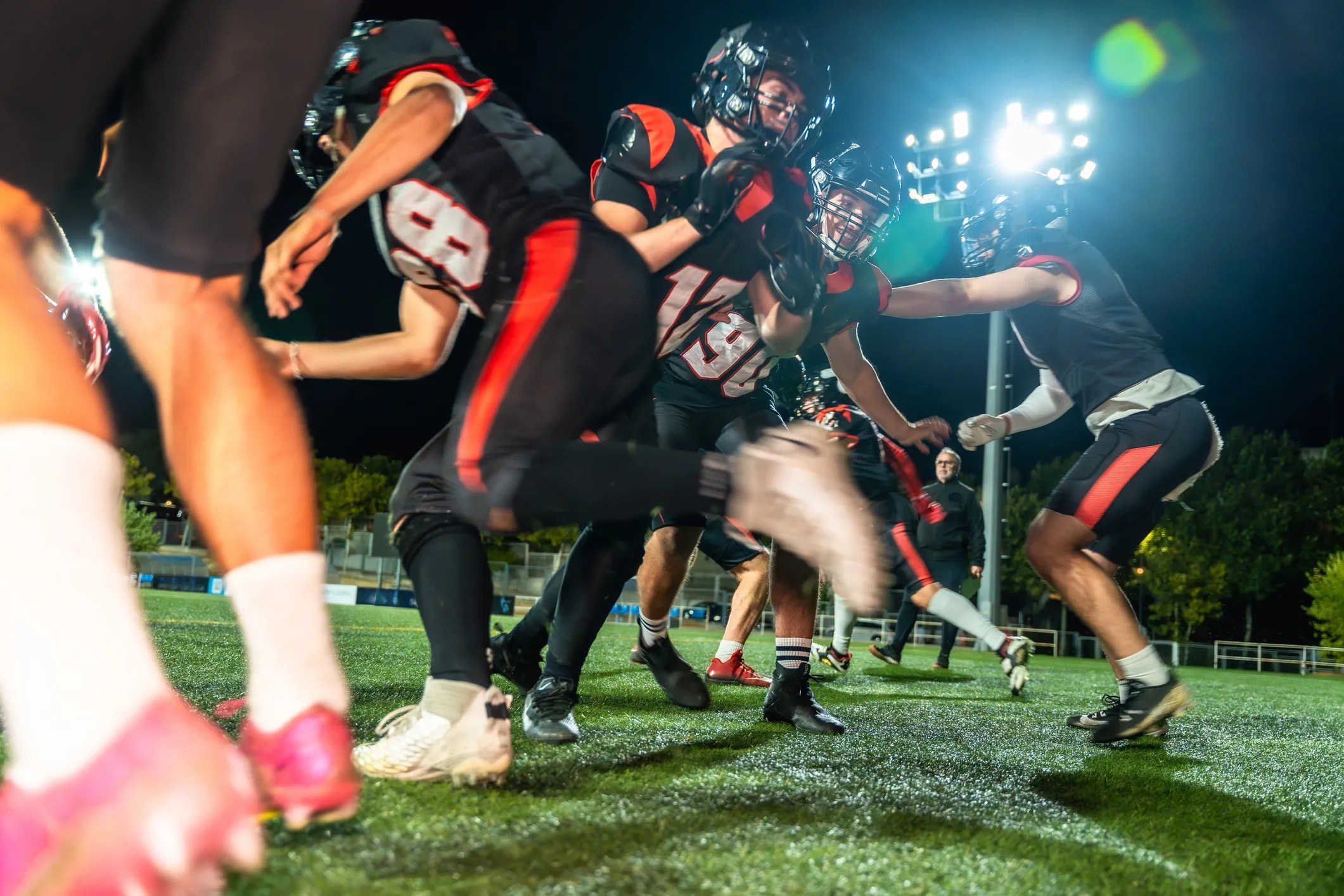
The sports playing surface beneath football players’ cleats contributes to their performance and safety. While debates prevail about the relative safety of natural grass and artificial turf, research underscores the importance of evaluating individual fields on measurable characteristics rather than just surface type. Testing and monitoring athletic surfaces for factors, such as impact attenuation, surface abrasiveness, and permeability, helps sports facilities make educated choices about field quality, supporting athletes’ performance and safety.
By adhering to ASTM test methods for sports playing surfaces, facility managers can better evaluate field performance, identify potential safety concerns, and make informed decisions about installation, maintenance, and long-term sports playing surface quality.
Playing Surface Performance
Besides training harder, eating cleaner, or upgrading gear, improved performance also is largely dictated by the field itself. Cushion technology in athletic court surfaces has revolutionized the long-term health of an athlete. Because it protects player safety, cuts down joint fatigue, and improves physical performance (compared to traditional hard concrete or plain asphalt), court surface technology has a significant impact on both athlete safety and performance.
Each sprint, jump, tackle, cut, and pivot generates force that travels through the feet and up the body of an athlete; over time, repeated exposure to these impacts can increase stress on muscles, joints, and lower back. Since the sports surface influences how players interact with the field, evaluating the actual playing surface is essential for helping identify performance risks.
ASTM Standards Help Evaluate Sports Surfaces
ASTM International develops voluntary consensus standards that provide common methods for measuring and evaluating material and product performance. For sports fields, these standards help testing professionals assess specific characteristics using defined procedures.
Measuring Impact Attenuation
One important consideration is impact attenuation: a surface’s ability to reduce the forces associated with an impact. In football, it specially refers to a material, helmet, or playing surface’s ability to absorb, slow down, and spread out kinetic energy during a collision or fall. Beyond player-worn gear like helmets and add-on shells, turf systems, and shock pads must maintain consistent impact attenuation to soften hard falls onto the ground.
ASTM F1936: Impact Attenuation of Turf Playing System
To accurately assess the impact attenuation an athlete will encounter on an installed field, that specific field must be tested in situ. ASTM F1936, Standard Specification for Impact Attenuation of Turf Playing Systems as Measured in the Field establishes an in-situ test method and maximum impact attenuation value for all types of turf playing systems and for a number of sport-specific field layouts. The standard is particularly useful because it evaluates the installed playing surface rather than relying solely on laboratory testing of individual materials. Its scope includes natural turf, synthetic turf, and combination systems.
ASTM F355: Impact Attenuation of Playing Surface Systems
ASTM F355, Standard Test Method for Impact Attenuation of Playing Surface Systems, Other Protective Sport Systems, and Materials Used for Athletics, Recreation and Play provides another method for measuring impact attenuation under prescribed test conditions. This test method measures the impact attenuation of surface systems and materials, specifically the peak impact acceleration (“impact shock”) and calculates the Head Injury Criteria produced under prescribed impact conditions. It is applicable to impact attenuating mats and padding used in sports facilities, including, but not limited to: stadium wall padding, gymnastic mats, wrestling mats, turf playing systems, pole vault landing systems, and playground protective surfacing.
Evaluating Surface Abrasiveness
When football players dive, tackle, or slide on artificial turf, exposed skin friction against plastic blades and infill produces friction burns (i.e., abrasions). These account for a significant percentage of minor-to-moderate injuries (such as up to 19.3% of turf-related skin or surface trauma in sport studies). Thus, it is important to consider how a surface interacts with players when they fall or slide. ASTM F1015, Standard Test Method for Relative Abrasiveness of Synthetic Turf Playing Surfaces provides a method for assessing the relative abrasiveness of synthetic turf. The results can help characterize differences between surfaces and inform decisions about turf materials and system design. It is applicable to both laboratory and field measurement of synthetic turf surfaces used for sports.
Considering Permeability
Because water drains straight through the turf backing and base stone, teams can play shortly after heavy rainstorms without waiting for mud to dry. Permeability is thus an important aspect in turf surfaces because it dictates how fast water can move downward into and through the synthetic turf base stone.
ASTM F2898, Standard Test Method for Permeability of Synthetic Turf Sports Field Base Stone and Surface System by Non-confined Area Flood Test Method provides a test method that can be used to determine the permeability rate of synthetic turf playing field systems. It is applicable for synthetic turf playing field systems and stone bases where system is designed for permeability through the synthetic turf surface and or through a base stone surface. This test method is also suitable for synthetic turf playing systems that are directly underlined with resilient and non-resilient pre-molded drainage boards systems and porous pavement base systems.
Learn More About Sports Playing Surfaces
ASTM Standards for Safe Sports Surfaces & Injury Prevention