


ISO 9001 is the world’s most widely recognized quality management system (QMS) standard, defining, improving, and documenting processes for over one million organizations across 189 countries. Now, the next major revision is here. ISO 9001:2026 replaces ISO 9001:2015 and introduces updates designed to reflect today’s business realities: digital transformation, resilience, ethics, organizational culture, and sustainability-driven stakeholder expectations. The 2026 edition of ISO 9001 builds on the familiar, trusted approach. ISO 9001:2026—Quality management systems – Requirements keeps the core framework, but reflects how organizations operate today: more interconnected, more exposed to disruption, more digital, and more accountable to customers, regulators, employees and society.
What Is ISO 9001:2026?
ISO 9001:2026 is the internationally recognized standard for Quality Management Systems (QMS). It provides a framework for organizations to assure that products and services consistently meet customer and regulatory requirements. The international standard focuses on performance improvement, risk-based thinking, and continuous improvement, applicable to any industry or business size. At its core, it is about knowing the organization and understanding its customers.
Overall, ISO 9001:2026 helps organizations address all aspects of managing the quality of their products and services, with an emphasis on customer satisfaction and constant enhancement of the quality management system.
Why ISO 9001 Is Being Revised?
ISO standards undergo regular review to assure they remain relevant. ISO 9001:2015 was published over a decade ago and introduced risk-based thinking, stronger leadership accountability, and alignment with other management system standards. Since then, organizations have experienced profound shifts in the following:
- Accelerated digital transformation
- Expanded use of remote and hybrid work models
- Increased focus on organizational resilience
- Greater emphasis on environmental and social responsibility
- Rising stakeholder expectations around ethical governance
In response, ISO’s technical committee reached broad international consensus to revise the standard and align it with modern operational realities. In February 2026, ISO reported participation from 81 experts representing 46 countries and liaisons, highlighting the scale of global collaboration behind the revision.
What Is Changing in ISO 9001:2026?
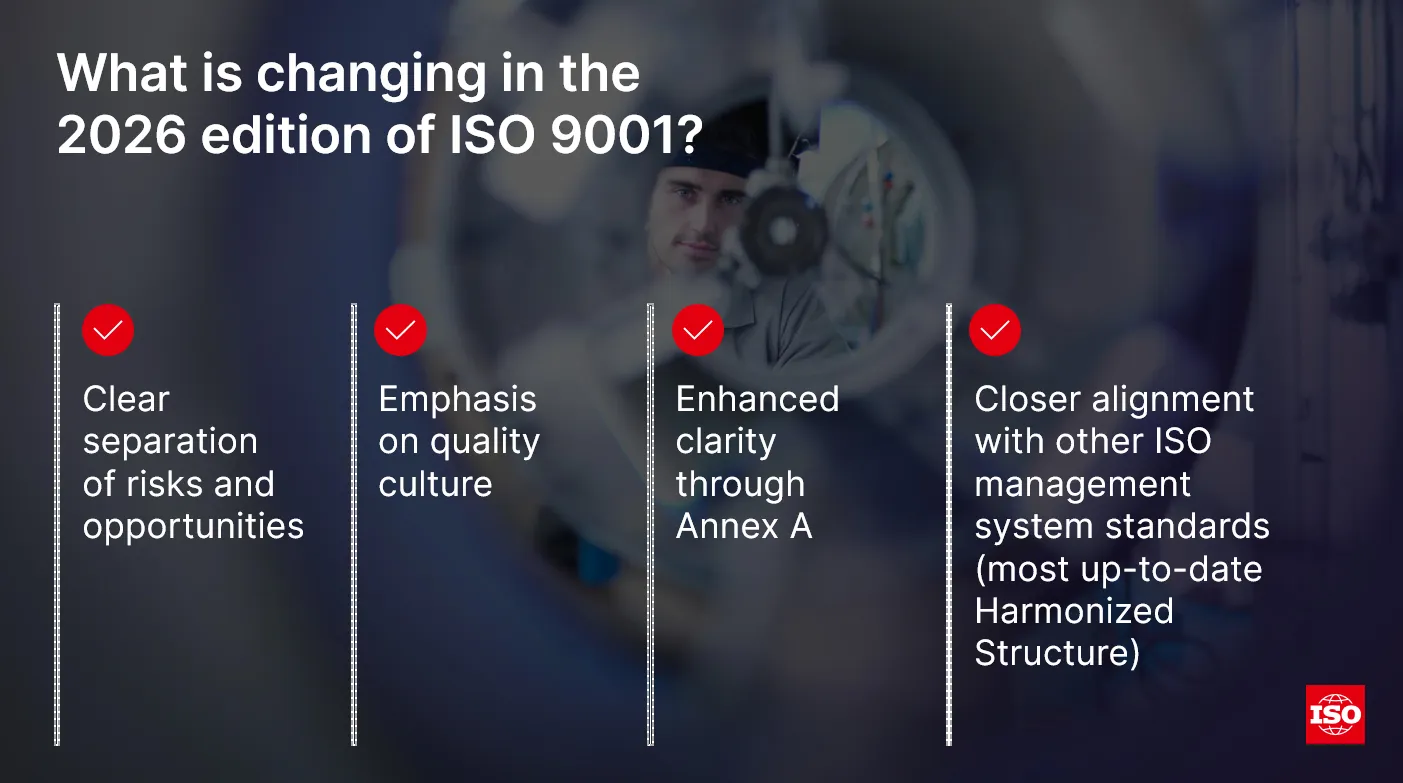
The revision primarily maintains the 2015 version’s core framework, process approach, and fundamental requirements, focusing on editorial improvements and clarifications rather than the substantive advancements many stakeholders had anticipated. The main changes in ISO 9001:2026 are as follows:
Inclusion of Core ISO Management System Terms and Definitions
Clause 3 of the document now includes a limited number of terms and definitions. ISO 9000 remains the normative reference for all quality management terms and definitions.
Introduction of Quality Culture and Ethical Behavior
Quality culture and ethical behavior are now addressed within the requirements, particularly in relation to leadership, awareness and the environment for the operation of processes.
Separation of Risks and Opportunities
Risks and opportunities are more clearly distinguished, with separate consideration of actions to address each.
Strengthened Management of Change
Requirements related to changes to the quality management system have been reinforced to support the achievement of intended results.
Enhanced Explanatory Content in Annex A
Annex A has been revised to provide enhanced clarification of the structure, terminology, and intent of the requirements as informative text, without introducing additional requirements.
Removal of Annex B
It previously provided information on other ISO/TC 176 standards. References to these standards are now included in Annex A and on the ISO/TC 176 website.

Organizations already using ISO 9001:2015 should review how their quality management system addresses the updated requirements, especially those relating to leadership and culture.
What Is Not Changing
Organizations already certified to ISO 9001:2015 should not expect a complete overhaul. Core principles of the standard remain intact: customer focus; process-based management; continual improvement; evidence-based decision making; leadership engagement; and risk-based thinking. Thus, for organizations that already have an effective ISO 9001:2015 quality management system, the transition will not be a complete rebuild.
Quality Management Systems Transition Set
To help your organization prepare for the 2026 edition of ISO 9001, ISO 9001:2026 / ISO 9001:2015 – Quality Management Systems Transition Set provides organizations with the 2015 and 2026 editions of ISO 9001 to support side-by-side comparison, gap analysis, and transition planning. By reviewing the changes between ISO 9001:2015 and ISO 9001:2026, quality professionals can identify areas of their existing quality management system that may need to be updated while maintaining established processes and practices. The set can help quality managers, auditors, consultants, certification professionals, and organizations understand the revised requirements and prepare for a structured transition to ISO 9001:2026.
The Future of Quality Management
Quality management is about building resilient, ethical, digitally enabled systems capable of adapting to change while consistently delivering value to customers. Organizations that embrace these shifts early will not only simplify future certification transitions, they will also strengthen operational performance in an increasingly complex business environment.
ISO 9001:2026 represents not just an update to a standard, but a blueprint for the next generation of organizational excellence. As such, the refinements in ISO 9001:2026 will shape how organizations approach quality management for the next decade.
What Benefits Will ISO 9001:2026 Bring to a Business or Organization?
Implementing a Quality Management System (QMS) helps improve efficiency, manage
risks, meet regulatory requirements, and consistently enhance customer satisfaction. Implementing a QMS can help a business or organization achieve the following:
- Assess internal and external issues that may affect intended results.
- Determine whether climate change is a relevant organizational issue.
- Identify affected interested parties and understand their expectations.
- Determine which interested party requirements the quality management system must address.
- Define clear objectives and identify opportunities for improvement and growth.
- Prioritize customer needs and consistently enhance satisfaction.
- Promote a culture of quality, integrity, and ethical behavior.
- Align, understand, and effectively manage organizational processes.
- Meet applicable statutory and regulatory requirements.
- Identify and address risks and opportunities.
- Strengthen resilience against disruptions, supply-chain pressures, changing customer expectations, and technological change.
- Support expansion into new markets where some sectors and clients require ISO 9001 before doing business.
Overall, ISO 9001:2026 can help organizations build more resilient, customer-focused, and effective quality management systems.
Where to Find ISO 9001:2026
The question is no longer whether ISO 9001:2026 is coming—it is whether your organization will be ready now that the standard is here. ISO 9001:2026—Quality management systems – Requirements is available on the ANSI Webstore.
This standard is also available in these packages:
- BS ISO 45001 / ISO 9001 / ISO 14001 – Occupational Health and Safety Requirements Package
- ISO 10012 / ISO 9000 / ISO 9001 Quality Measurement Management Systems Package
- ISO 10015 / ISO 10018 / ISO 9001 – Quality Management – People Engagement and Development Package
- ISO 10018 / ISO 9001 / ISO 14001 – Quality and Environmental Management ESG Package
- ISO 13485 / ISO 9001 – Medical Devices Quality Management Set
- ISO 45001 / ISO 9001 / ISO 14001 – Occupational Health and Safety Requirements Package
- ISO 50001 / ANSI/MSE 2000 / ISO 9000 / ISO 9001 – Energy and Quality Management Package
- ISO 50001 / ISO 9001 / ISO 14001 – Energy Quality and Environmental Management Systems Package
- ISO 9000 / ISO 9001 / ISO 9004 / ISO 19011 – Quality Management Package
- ISO 9000 Collection 1
- ISO 9000 Collection 2
- ISO 9001 / ISO 10017 – Quality Management Statistical Techniques Set
- ISO 9001 / ISO 13485 – Quality Management for Medical Devices Set
- ISO 9001 / ISO 14001 – Quality and Environmental Management Set
- ISO 9001 / ISO 14001 / ISO/IEC 27001 / ISO 31000 / ISO 55001 / ISO 22301 – ISO Requirements Collection
- ISO 9001 / ISO 19011 – Quality Management Auditing Set
- ISO 9001 / ISO 9004 / ISO 10010 – Quality Management ESG Package
- ISO 9001 / ISO/TS 9002 – Quality Management Systems Set
- ISO 9001 and ISO 9000 – Quality Management Set
- ISO 9001 and ISO/TS 16949 Automotive Production Quality Management Systems
- ISO 9001 Quality Management for Small Businesses Package
- ISO/IEC 17025 / ISO 9001 – Quality Management Requirements for Testing and Calibration Laboratories Set
- ISO/IEC 20000-1 / ISO/IEC 27001 / ISO 9001 – Information Technology Quality Management Package
- ISO/IEC 27001 / ISO 9001 – Information Technology Quality Management Set
- ISO/IEC 27001 / ISO/IEC 27002 / ISO 9001 – Quality and Information Security Management Package
- Personnel Certification
- SAE AS 9100D and ISO 9001 – QMS Requirements Set
You can also learn more about ISO 9001:2026 in our blog posts: