
The Hidden Cost of Manual Compliance Tracking in Field Operations

According to the U.S. Chamber of Commerce: 47% of small businesses say they spend too much time fulfilling compliance requirements, and 51% say regulatory compliance is negatively impacting growth. For field-service organizations, that time is not spent in a back office. It is spent in trucks, on job sites, and in the kitchen at 9 p.m. with a stack of carbon-copy work orders.
Why Field Operations Compound the Compliance Problem
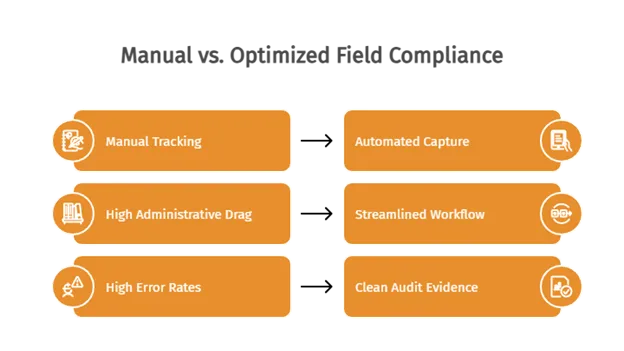
If it is not written down, it did not happen. In a field-service context, this documentation principle collides with operational reality. A technician finishes a fire alarm inspection at 4:45 p.m., drives 40 minutes to the shop, and either fills out the paperwork accurately while tired, fills it out badly, or leaves it for tomorrow. None of those three outcomes produces clean audit evidence.
The drag is measurable. One field-operations analysis estimates that manual tracking systems require two to three hours of administrative work for every hour spent collecting field data, and reduce field-team productivity by 25 to 35% through redundant data entry and communication delays. The same analysis pegs manual data entry error rates at 1 to 5%.
Apply that to a mid-sized service company running 30 technicians who each generate five compliance-relevant documents per day. That is 750 documents a week. A 3% error rate means roughly 22 records every week that will misrepresent what actually happened on a job site, and almost none of those errors will be caught until an auditor finds them.
The Specific Compliance Surfaces Field Companies Touch
When standards people hear “compliance,” they often picture ISO certifications and management-system audits. Field operators live with a wider set of obligations, often simultaneously, which include:
- Labor and wage compliance. Prevailing wage rules under Davis-Bacon and state-level equivalents require verifiable on-site hours by classification. Based on usage patterns, traffic control companies managing rotating crews across municipal contracts depend on time card and GPS data more for compliance reporting than for payroll itself, since prevailing wage audits hinge on verifiable on-site hours.
- Inspection and recurring service records. Fire service, backflow testing, elevator service, and HVAC refrigerant tracking all require dated, signed evidence of recurring visits. Based on usage patterns, fire service companies running quarterly and annual inspection routes get the most leverage out of recurring work order templates, since the same site can generate 4 to 12 scheduled visits per year with near-identical task lists.
- Safety and OSHA recordkeeping. Toolbox talks, equipment inspections, and incident reports all need contemporaneous documentation.
- Insurance and certificate-of-insurance tracking. Subcontractor onboarding for construction and property management firms produces a documentation load that one industry analysis estimates at 20 hours per week in manual workflows.
- Corporate good-standing and licensure. Missing a renewal can be quietly catastrophic. As Wolters Kluwer notes, failing to file annual reports or pay franchise taxes can cause loss of good standing, administrative dissolution, or revocation of authority to do business in some states.
Each surface, on its own, is manageable. Stacked, with paper or disconnected spreadsheets as the substrate, they produce the audit scramble that one compliance analysis bluntly describes: records scattered across inboxes, file shares, and spreadsheets, with admins consuming 10 to 20+ hours per month just keeping pace.
The Reporting Gap Nobody Sees Until They Lose a Bid
The cost most field-service owners underestimate is not the audit itself. It is the proposal they could not respond to.
When a municipality or a national property manager issues a request for proposal (RFP), the qualification packet now routinely asks for first-time-fix rates, average response time by service category, technician certification status, safety incident rates per 200,000 labor hours, and on-time completion percentages over a defined lookback period. A company tracking work orders on triplicate forms cannot produce those numbers in 72 hours. They can produce them in two weeks, after someone tallies binders by hand.
This is where the compliance burden quietly becomes a revenue ceiling. The U.S. Chamber’s Q4 2024 data also shows that 69% of small businesses say they spend more per employee to comply with regulations than larger competitors. That gap is not because the rules are different. It is because larger competitors have already digitized the evidence layer.
What Quality Documentation Actually Requires in the Field
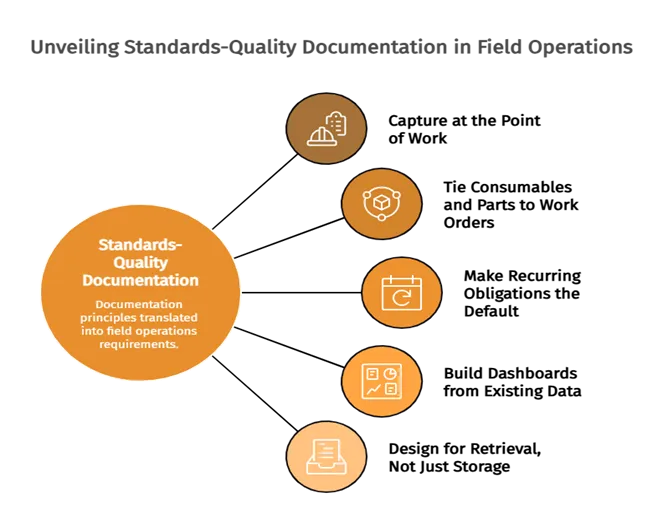
To translate documentation principles into field-operations design requirements, put them in this order:
1. Capture at the point of work. Evidence created on the job site (with timestamp, GPS coordinates, photos, and a customer signature) is structurally more defensible than evidence reconstructed at the shop. This is the core argument for mobile-first capture, not as a productivity feature but as a chain-of-custody feature.
2. Tie consumables and parts to the work order. Construction general contractors (GCs) running multiple concurrent jobs cite purchase order tracking tied to specific projects as the feature that most directly cleans up year-end job costing, particularly when material orders cross over between sites. The same principle applies to compliance-relevant materials: refrigerant logs, controlled substances in pest control, lead-safe work practices documentation.
3. Make the recurring obligation the default. A quarterly inspection that exists only as a calendar reminder in one person’s head is a compliance failure waiting to happen. The schedule should be the system of record, with the visit auto-generating the documentation shell.
4. Build dashboards from the data you already capture, not from a separate reporting workflow. A compliance program that requires a separate monthly reporting effort is one that will be skipped during busy season. Reasonable starter KPIs, drawn from InCorp’s 2025 compliance guidance, include training completion rate, audit finding resolution time, number of compliance incidents, and policy update implementation rate.
5. Design for retrieval, not just storage. Paper records are stored. Digital records are retrievable. An auditor asking for “every refrigerant recovery log from this technician between March and June 2024” should be a five-minute query, not a weekend project.
The Operator Math That Finally Moves Owners
Field-service owners do not change systems because of compliance fear. They change because of operator math.
Contractors run recurring weekly or biweekly routes for the bulk of revenue, and route-density gains in the 15-30% range are common in the first full season after switching from paper schedules to map-based dispatch. The compliance documentation becomes a byproduct of that operational change, not the reason for it. The same digital work order that tightens the route also produces the timestamped, geotagged, signature-bearing record that satisfies a labor auditor.
Electrical and alarm installers managing inventory of high-value parts see fewer truck-stock write-offs when equipment tracking is tied directly to the work order, since techs are accountable for what leaves and arrives at the warehouse. Inventory accountability and compliance documentation, in practice, are the same problem solved twice.
An Operator Takeaway
If you run field operations, the question is not whether your paper system technically works. It is whether you could produce a clean, query-able answer to an auditor’s question (or an RFP’s qualification section) within a single business day. If the honest answer is no, the hidden cost is already on your books. You just have not received the invoice yet.
Note: Usage patterns and customer behavior described here are based on aggregated data from Field Promax users.
Contributing Author: Joy Gomez
Joy Gomez is an engineer, process automation expert, and the Founder of Field Promax. Known for his technical expertise and commitment to field service innovation, Joy writes about transforming traditional business models into paperless, efficient operations. He is a Lean Six Sigma Black Belt based in Rochester, MN, dedicated to helping field professionals work smarter through better technology. Connect with him on LinkedIn.