ISO/IEC 3532-1:2023—3D Printing in Medicine
3D printing technology has caused a revolution in health care delivery. It is being widely adopted for various applications, including anatomical modeling, surgical planning, the creation of custom implants and prosthetics, and even drug delivery systems. Due to its transformative potential in healthcare, 3D printing is the future of medicine. ISO/IEC 3532-1:2023— Information Technology – Medical Image-Based Modelling For 3D Printing – Part 1: General Requirements addresses the overview of medical image processing and requirements for image-based modeling.
How Does 3D Printing in Medicine Work?
3D printing is an additive manufacturing technique that creates three-dimensional objects by building successive layers of raw material such as metals, plastics, and ceramics. In medicine, this involves the creation of physical replicas of anatomical structures. A digital computer model is developed to describe the structures, derived from patient-specific models from 3D imaging processes like (MRI) and X-ray CT, to be printed. This enables the manufacturer to easily make changes or adapt the product as needed.
Is important to note that to perform 3D printing for medical practices, an accurate and consistent approach for image processing and data creation from medical images is needed. Standardization for 3D printing processes in medicine is required for education, diagnosis, neurosurgical treatment, developing simulation models, medical equipment (including surgical guides), and surgical implantable devices in the clinical fields. ISO/IEC 3532-1:2023 provides requirements for software-based medical image processing for the purpose of producing 3D models for 3D printing.
What Is ISO/IEC 3532-1?
ISO/IEC 3532-1:2023 specifies the requirements for medical image-based modelling for 3D printing for medical applications. The standard concerns accurate 3D data modelling in the medical field using medical image data generated from computed tomography (CT) devices. ISO/IEC 3532-1:2023 also specifies the principal considerations for the general procedures of medical image-based modelling.
This standard excludes soft tissue modelling from magnetic resonance image (MRI).
How Is 3D Printing Technology Used in Health Care and Medicine?
Due to 3D printing technology, medical device designers and practitioners can practically and efficiently create devices previously difficult or impossible. 3D printing in healthcare is often used to create intricate scaffolds that mimic the structure of human tissues or organs. These scaffolds provide a framework for cells to grow and adhere to, facilitating tissue regeneration.
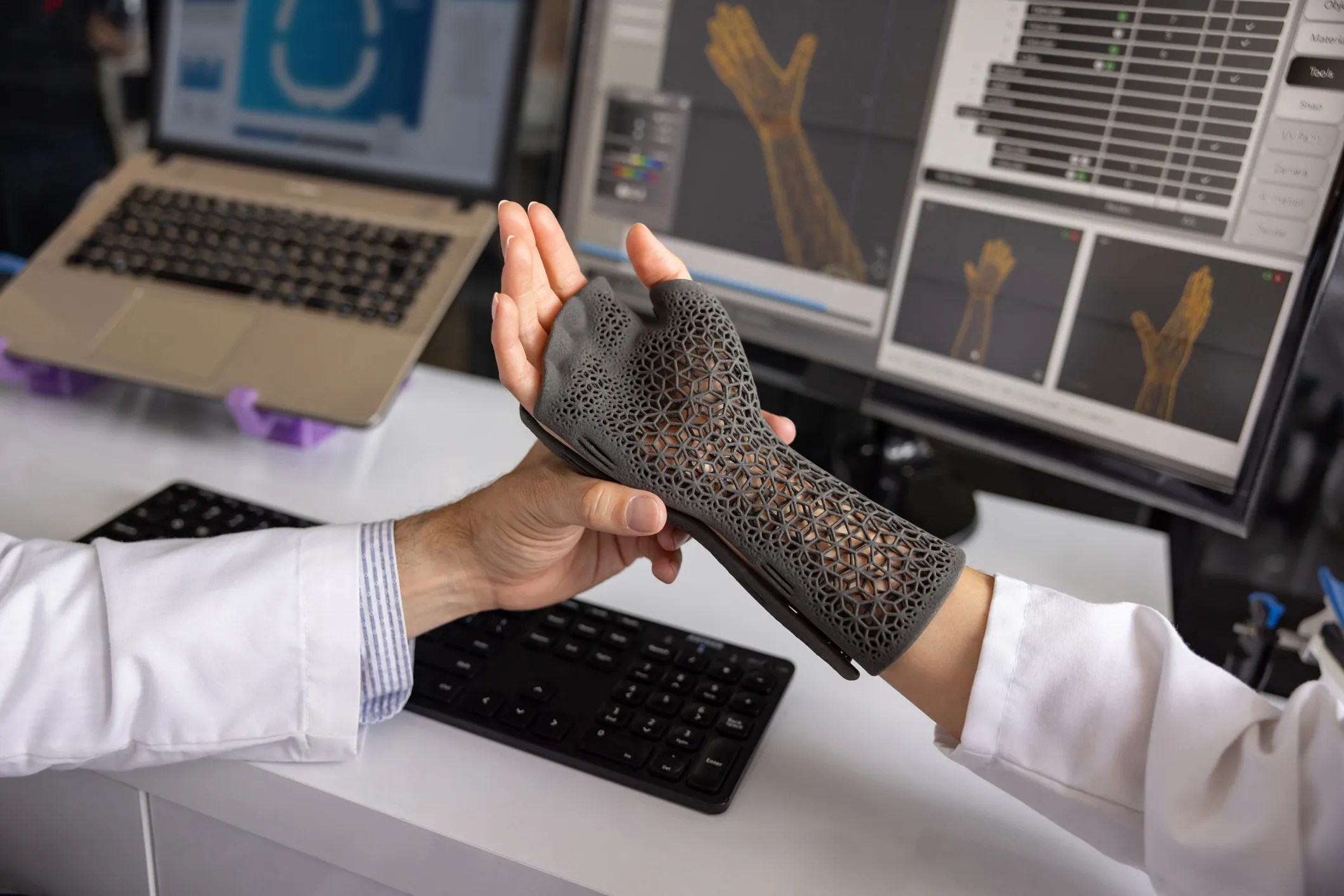
Besides using 3D printing technology to create standard medical devices, clinicians and engineers are working in conjunction to produce patient-specific devices or patient-matched devices. These are medical devices designed to fit a specific patient’s anatomy, typically using medical imaging from that patient. Anatomically matched devices have very complex geometrical contours and shapes.
Can 3D Printer Products Be Used in Surgery?
3D printer products are increasingly being used in surgical procedures because they enable the creation of patient-specific anatomical models, surgical guides, and implants. They help enhance surgical precision, efficiency, and planning. As such, 3D-printed models also serve as valuable educational aids for surgical training.
Benefits of 3D Printing in Medicine and Healthcare
3D printer models complement on-screen visualizations, helping build confidence in healthcare decisions. 3D printing specifically provides professionals the beneficial ability to visualize, explore, and further comprehend the complex anatomy as a real three-dimensional object. These objects/models serve as convenient tools to trial the placement of implants and other medical devices as well as to envisage surgical activities. Advancements such as multi-color and multi-material 3D printing can also help to better simulate the surgical environment for pre-surgical planning and intra-operative reference.
ISO/IEC 3532-1:2023— Information Technology – Medical Image-Based Modelling For 3D Printing – Part 1: General Requirements is available on the ANSI Webstore.