ISO 14001:2015 – Environmental Management Systems Requirements

Some facts about the environment that may shock you include: around 27,000 trees are cut down each day; 78% of marine mammals are at risk of choking on plastic; Americans throw away 25 trillion styrofoam cups every year; a glass bottle can take up to 1 million years to decompose; and on average, one supermarket goes through 60 million paper bags each year. Environmental management helps minimize the negative impact of human activities and business operations on the natural environment. ISO/FDIS 14001:2026 – Environmental management systems – Requirements with guidance for use specifies the requirements for an environmental management system that an organization can use to enhance its environmental performance.
What Is ISO/FDIS 14001:2026?
ISO/FDIS 14001:2026 is the Final Draft International Standard for environmental management systems (EMS). It has been approved by ISO members worldwide to be published as ISO 14001:2026. Final production steps are under way so that it will replace ISO 14001:2015 before the end of April.
What Is New in ISO/FDIS 14001:2026?
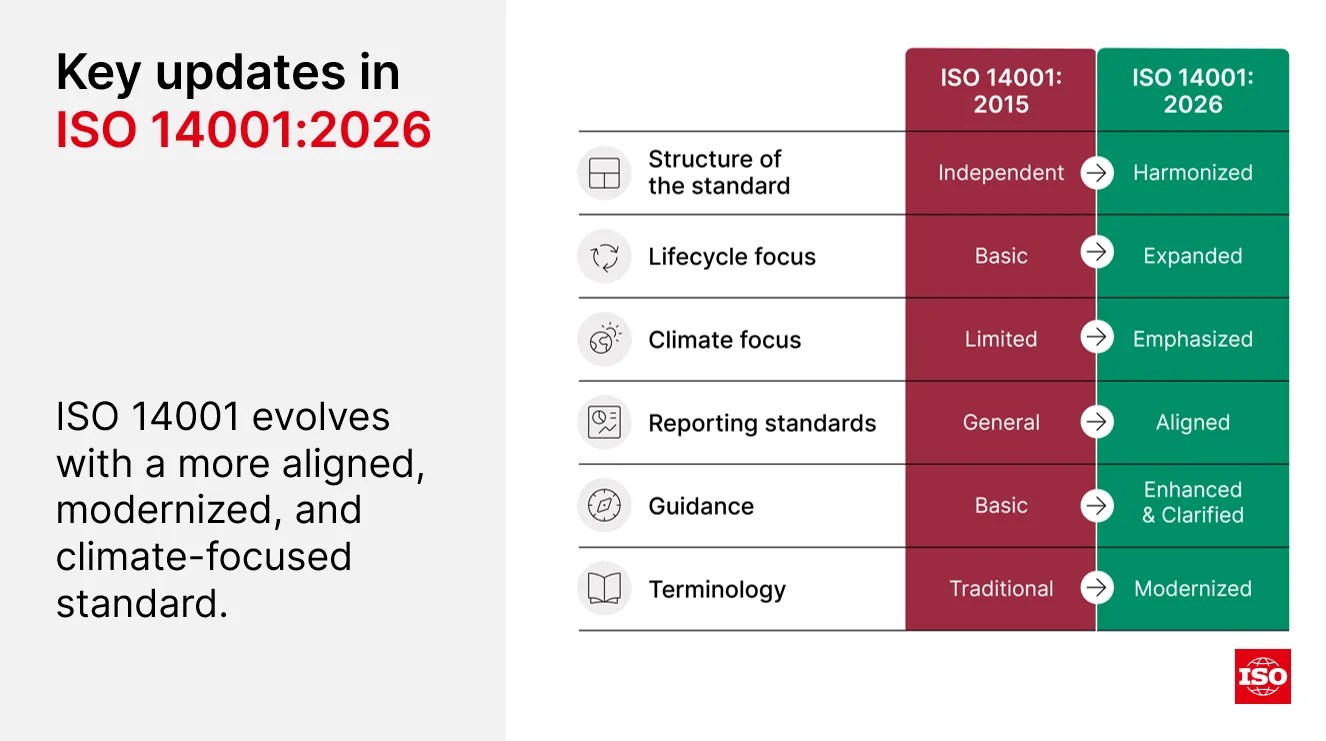
The 2026 edition of ISO 14001 introduces editorial improvements that make the standard easier to understand, implement, and integrate with other management systems. The standard also strengthens links to broader sustainability goals and clarifies how environmental conditions both affect and are affected by your organization.
Sharper Focus on Environmental Sustainability
Updated introduction and guidance offer stronger alignment with today’s environmental priorities such as climate action, biodiversity and resource efficiency. New guidance helps organizations consider how their local environmental conditions (e.g. climate change effects, biodiversity loss, water availability) affect their operations – and vice versa.
Taking Business Decisions into Account
ISO 14001:2026 reinforces what matters most: environmental protection and business outcomes. The updated standard empowers organizations everywhere to improve performance, cut costs and stay compliant, while building credibility and making a tangible difference for the planet. The standard now clarifies how environmental management should align with your organization’s purpose, strategic direction, and risk-based thinking.
Improved Terminology and Usability
The 2026 edition benefits from better clarity and readability, making it easier for organizations of all sizes and sectors to interpret the requirements and implement the standard effectively. Terms such as ‘meet compliance obligations’ replace previous wording to ensure consistency across ISO standards. The harmonized structure makes integration with other management systems even smoother.
What Has Not Changed in ISO/FDIS 14001:2026?
No new requirements have been added in ISO/FDIS 14001:2026, meaning that the core structure and intent of the standard remain the same. Organizations already certified to ISO 14001:2015 will find the transition smooth and straightforward.
What Is ISO 14001:2015?
The environment has always been an issue that needed to be top-of-mind. Unfortunately, it has taken years of neglect and anthropogenic impact for this to be recognized. With the effects of problems like climate change looming, many organizations look to ISO 14001:2015, the international standard for environmental management system (EMS) requirements.
ISO 14001, in specifying the requirements for an environmental management system, can help an organization enhance its environmental performance, fulfill compliance obligations, and achieve environmental objectives.
The international standard, which is applicable to any organization, regardless of size, type, and nature, helps companies meet these goals by outlining the significance of planning, leadership, support, operation, and considering the organization’s context in an environmental management system. Like other ISO management systems standards, ISO 14001:2015 makes use of the Plan-Do-Check-Act (PDCA) model for continual improvement.
Why Use ISO 14001? What are the Benefits?
The benefits of realizing an EMS are multitudinous. Beyond improving an organization’s environmental performance, thereby helping them limit environmental harm and meet societal expectations for sustainability, there are many tangible effects to gain that improve daily operations.
Some realistic, but not all, desirable results from an environmental management system include improved control and management of emissions, effluents, and wastes, reduction in generated wastes, energy efficiency improvements and cost savings, conservation of natural resources, and control in the pursuit of environmental initiatives that align with business priorities.
Changes to ISO 14001:2015
ISO 14001:2015 – Environmental Management Systems – Requirements with guidance for use was released on September 14, 2015. Significant changes to this revision of the 2004 version of the standard include a greater commitment from leadership, increased alignment with strategic direction, greater environmental protection, more effective communication, and the inclusion of life-cycle thinking.
The 2015 edition of ISO 14001 revised the 2004 version of the same standard for environmental management systems, and it incorporated the Technical Corrigendum ISO 14001:2004/Cor1:2009.
Taking in the adapting needs of environmental management and harmonizing it with recent revisions of ISO management systems standards, ISO 14001:2015 underwent numerous changes. These include:
- Updates to better consider the organization’s context, which can help leverage opportunities to help the organization and the environment.
- A new clause was added to emphasize the role of top leadership in an EMS.
- Expectations of organizations were expanded to commit to proactive initiatives to protect the environment from harm and degradation.
- The standard shifted to a focus on continual improvement.
- Environmental impacts now consider all stage of the life cycle (e.g. acquisition of raw materials, design, production, transportation/delivery, use, end-of-life treatment, and final disposal). You can read more on life-cycle thinking in our post ISO 14001 Life Cycle Assessment in Environmental Management.
- Organizations need to control or influence outsourced processes. This helps better understand externalities that can impact the environment.
- A communications strategy with equal emphasis on external and internal communications was added.
- The term “documented information” is used, instead of “documents” and “records.”
- Similar to other recent revisions of ISO management system standards, ISO 14001:2015 makes use of the shared High Level Structure (HLS) of the Annex SL (now called Annex L), which allows these management systems documents to be integrated with one another.
Get ISO 14001:2015
ISO 14001:2015 – Environmental Management Systems – Requirements With Guidance For Use is available on the ANSI Webstore.
Also available is the Redline version of ISO 14001:2015, which provides a simple way to compare all the changes to this revision from the previous version of the standard.
This standard, as it can be easily integrated with numerous other ISO management systems standards, if often needed to be used in tandem with other standards documents. To help meet this need, ANSI offers ISO 14001 and relevant standards together as standards packages, which bundle the documents together at a discount.
ISO/FDIS 14001:2026 is available as part of the following standards packages:
- ANSI/ASSP Z10.0 / ISO 14001 / BS ISO 45001 – Occupational Health and Safety Management Package
- BS ISO 45001 / BS 45002-0 / ISO 14001 – Occupational Health and Environmental Management Package
- BS ISO 45001 / BS ISO 45002 / ISO 14001 – Occupational Health and Environmental Management Package
- BS ISO 45001 / ISO 14001 – Environmental and Occupational Health Management Systems Package
- BS ISO 45001 / ISO 9001 / ISO 14001 – Occupational Health and Safety Requirements Package
- ISO 10018 / ISO 9001 / ISO 14001 – Quality and Environmental Management ESG Package
- ISO 14000 Collection 1
- ISO 14000 Collection 2
- ISO 14001 / ISO 14002-1 / ISO 14004 / ISO 14006 – Environmental Management Systems ESG Package
- ISO 14001 / ISO 14004 / ISO 19011 / ISO 14050 – Environmental Management Package
- ISO 14001 / ISO 50001 – Energy and Environmental Management Systems Set
- ISO 26000 Guidance on Social Responsibility and ISO 14000 Collection 1
- ISO 45001 / ISO 14001 – Environmental and Occupational Health and Safety Set
- ISO 45001 / ISO 9001 / ISO 14001 – Occupational Health and Safety Requirements Package
- ISO 50001 / ISO 9001 / ISO 14001 – Energy Quality and Environmental Management Systems Package
- ISO 9001 / ISO 14001 – Quality and Environmental Management Set
- ISO 9001 / ISO 14001 / ISO/IEC 27001 / ISO 31000 / ISO 55001 / ISO 22301 – ISO Requirements Collection
ANAB Accreditation for ISO 14001 Environmental Management Systems Certification Bodies
The planet and its ecosystems is a collection of resources shared by all, so ISO 14001 sees much use around the globe. To demonstrate the confidence of their environmental management system, many organizations choose to not only follow ISO 14001 but also receive certification to demonstrate their compliance of its requirements.
Environmental management systems certification bodies, however, also need a level of confidence passed to their practices. This is offered through accreditation. How else would you know if a certification issuer can be trusted.
The ANSI National Accreditation Board (ANAB) accredits ISO 14001 management systems certification bodies to the requirements of ISO/IEC 17021. The mark of ANAB accreditation for management systems certification bodies is a label of confidence and trust for anyone seeking certification in limiting their environmental impact.
You can learn more about Accreditation for ISO 14001 Environmental Management Systems here or search for ANAB accredited ISO 14001 management systems bodies here.
Additionally, you can learn more about ISO 14001:2015 in our video:






I learnt new things and information from your article.You have done a brilliant job. Let’s keep it up.
Very nice and an informative post on ISO 14001. Thanks for sharing!
This article beautifully encapsulates the significance of ISO 14001:2015 in setting the benchmark for environmental management systems. As we navigate an era where environmental sustainability is non-negotiable, understanding and implementing ISO 14001:2015 is indeed a strategic move for any organization.
I appreciate the thorough breakdown of the requirements. The emphasis on a proactive approach to environmental management and continual improvement resonates strongly. It’s not just about compliance; it’s about fostering a culture of environmental responsibility.
I find the integration of risk-based thinking particularly noteworthy. It not only aligns with ISO’s high-level structure but also reflects a forward-thinking approach to identifying and addressing environmental challenges.
The article effectively communicates the importance of leadership commitment and engagement at all levels. Environmental responsibility isn’t just a checkbox; it requires a collective effort and a mindset shift.
I’m curious to hear more from the community. How have other organizations navigated the implementation of ISO 14001:2015? What challenges did you face, and how did you overcome them? Share your insights, and let’s continue the conversation on advancing environmental management systems.
Kudos to the author for shedding light on this critical aspect of organizational sustainability!