


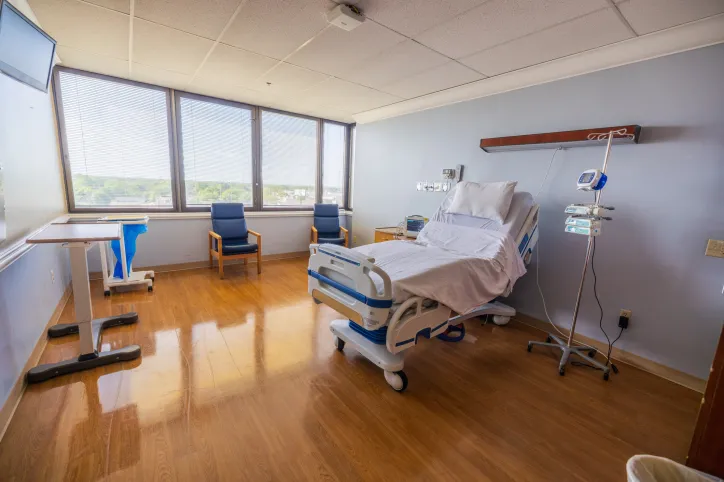
In health care facilities, ventilation goes beyond environmental comfort. Air handling and distribution systems, ultimately, control the transmission of airborne infection. This places a prime importance on their effective use, as well as the ANSI/ASHRAE/ASHE 170-2025: Ventilation of Health Care Facilities American National Standard.
The Importance for Air Quality in Health Care Facilities
With sanitary conditions, hordes of medical devices and equipment, and the attention of professionals, health care facilities—including hospitals, nursing facilities, and outpatient facilities—make up a network that supports our sense of comfort, well-being, and obviously, health.
In meeting such a need, they see a great deal of activity, and, in 2025, there were over 34.4 million admissions in all U.S. hospitals. By collecting so many sick people in one place, hospitals and other health care facilities provide a crucial service, but they must consider numerous factors to provide adequate public health.
Among the concerns for health care facilities, ventilation is critical.
About ANSI/ASHRAE/ASHE 170-2025
This standard’s ventilation system design requirements provide environmental control for health care facilities. These requirements address a multitude of interests, including odor, temperature, and humidity, that can be compromised without proper care and act as a hindrance to patient recovery.
In health care facilities, poor ventilation can be dire, as infectious agents can spread through airborne means. Furthermore, unfavorable indoor environmental conditions can worsen a patient’s symptoms or ailments. It is for these and other reasons that ANSI/ASHRAE/ASHE 170-2025 also details guidelines for environmental control for asepsis in health care facilities.
ANSI/ASHRAE/ASHE 170-2025 considers the chemical, physical, and biological contaminants that can affect the convalescence of patients and the delivery of their needed medical care, as well as the safety of patients, health care workers, and visitors. It is for use with new buildings and additions to existing buildings, and its requirements apply to patient care areas, resident care areas, and related support areas within health care facilities.
Changes to ANSI/ASHRAE/ASHE 170-2025
The ANSI/ASHRAE/ASHE 170 standard originated with an agreement between ASHRAE and the Faculty Guidelines Institute (FGI) that an ASHRAE standard would be the best location for health care industry ventilation guidelines, and the American Society for Health Care Engineering (ASHE) was also included in this process. In result, Standard 170 is updated on a four-year cycle in concert with documents published by FGI. The standard also publishes addenda annually.
The current edition of this American National Standard, ANSI/ASHRAE/ASHE 170-2025, revised the 2021 edition of the same document and went through the following changes:
- Addition of requirements for the optional use of natural ventilation.
- Calculation of total outdoor air at the systems level for systems serving both Standards 170 and 62.1 spaces.
- Updated requirements for Class 2 and 3 imaging rooms and their associated nonimaging spaces and clarification regarding nuclear medicine.
- Clarification of unoccupied turndown requirements in outpatient spaces.
- Clarification of separation distances and stack discharge heights based on complex situations.
- Additional function of space types for behavioral health.
- Updated cooling and heating reserve capacity and fuel on-site requirements.
- Reorganized and updated Section 10 for ventilation during construction.
- Indication of equivalent acceptable alternative filtration testing requirements to allow for easier international use of the standard.
- Updates to have similar requirements for similar space types across the different tables, when appropriate
- Clarification of bronchoscopy requirements.
- Provision of new space types to coordinate with FGI 2026 space types.
ANSI/ASHRAE/ASHE 170-2025: Ventilation of Health Care Facilities is available on the ANSI Webstore.
Changes to ANSI/ASHRAE/ASHE 170-2021
The last revision of this document, ANSI/ASHRAE/ASHE 170-2021, went through the following changes:
- Improved guidance on thermal comfort conditions in the revised scope.
- Extensive modifications to address the Outpatient and Residential sections.
- Addition of a new outpatient ventilation table to address nonacute-type spaces.
- Addition of new columns in the ventilation tables to prescribe filtration requirement and designate unoccupied turndown.
- Expanded guidance on separation distance requirements for varied intake and exhaust arrangements (this coordinates with related ASHRAE Standard 62.1 data).
- Expanded requirements to allow airborne infectious isolation room exhaust discharge to general exhaust under certain conditions.
- Improved guidance on space ventilation requirements needed for anesthetic gas use.
- Clarification of Class 1/Class 2/Class 3 imaging in coordination with FGI.
- Revised definition of “invasive procedure.”
- Improved guidance related to behavioral and mental health.
Changes to ANSI/ASHRAE/ASHE Standard 170-2017
Starting in 2018, the FGI documents consist of three separate books, so the 2017 edition of the standard for ventilation of health care facilities was reformatted into three sections: hospital spaces, outpatient spaces, and nursing home spaces. This allows for better coordination with the three FGI documents:
- Guidelines for Design and Construction of Hospitals
- Guidelines for Design and Construction of Outpatient Facilities
- Guidelines for Design and Construction of Residential Health, Care, and Support Facilities
Additional changes to ANSI/ASHRAE/ASHE Standard 170-2017 included:
- The addition of adiabatic humidifiers as an acceptable type of humidifier.
- A new type of exam room with lower guidelines for less acute applications.
- Clarification that controls to change pressure relationships between spaces are prohibited for all spaces.
- Reduction in guidelines for electroconvulsive therapy procedure rooms.
- Reduction in guidelines for laboratories when allowed by certain calculations.
- Higher guidelines for higher hazard exhaust airstreams.
- Coordination of space temperature guidelines in the Sterile Processing Department with other industry groups.
- Clarification of the definition of the primary diffuser array in operating rooms.
Questions About ANSI/ASHRAE/ASHE Standard 170?
Please direct any technical questions relating to this American National Standard to the developer. You can find the contact information for all ANSI-accredited standards developers here: List of ANSI-Accredited Standards Developers (ASDs).
For further information, please refer to: Who to Contact for Standards Related Questions.