


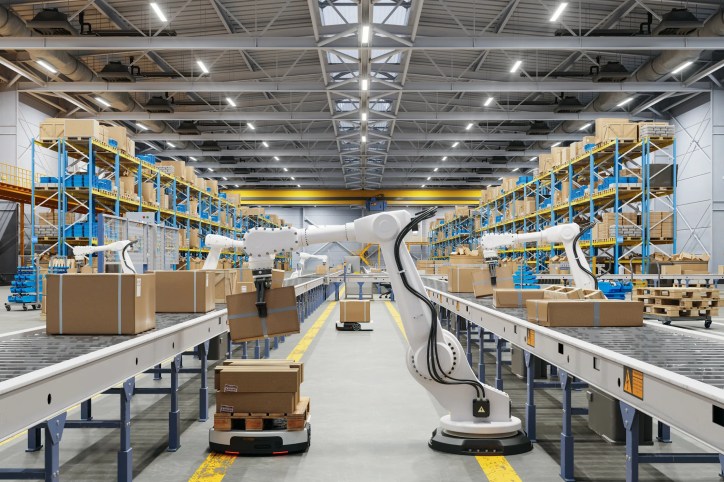
Mobile robotics is gaining momentum: industrial robots represented 63% of the market in 2025, followed by mobile robots at 32% and collaborative robots at 5%, and by 2031, mobile robots are forecast to become the largest segment, reaching a 45% market share. As industrial mobile robots grow in volume, it becomes paramount to assure that they safely interact with other machines, attachments, people, and software. ANSI/A3 R15.08-2-2023, Industrial Mobile Robots – Safety Requirements – Part 2: Requirements for IMR system(s) and IMR application(s) provides safety requirements for integrating, configuring, and customizing an industrial mobile robot (IMR) or fleet of IMRs within an industrial environment.
Why Industrial Mobile Robot Integration Matters for Safety
Industrial mobile robots (IMRs) were once confined to predictable, highly
controlled environments like e-commerce fulfillment centers and logistics
warehouses. Today, IMRs are being introduced onto active factory floors, complex manufacturing operations, and other industrial environments.
A robot may need to navigate around employees, transport materials, communicate with machinery, interact with workstations and conveyors, connect with charging equipment, and coordinate with other automated systems. These interactions can introduce safety considerations that may not be apparent when evaluating the mobile robot as an individual machine. This system-level perspective is central to ANSI/A3 R15.08-2-2023, which establishes safety requirements for IMR systems and IMR applications.
What Is ANSI/A3 R15.08-2-2023?
ANSI/A3 R15.08-2-2023 specifies safety requirements for industrial mobile robot systems and IMR applications. The standard covers three IMR types described in R15.08-1:
- IMR Type A: An autonomous mobile robot (AMR) without attachments.
- IMR Type B: An AMR with passive or active attachments, excluding manipulators. Examples include roller tables, conveyors, and linear lift devices.
- IMR Type C: An IMR consisting of an AMR or automated guided vehicle (AGV) used as a mobile platform with a manipulator as the attachment.
This classification helps distinguish different configurations and the safety considerations associated with integrating them into an industrial application.
ANSI/A3 R15.08-2-2023 is intended to provide guidance regarding applications primarily for use in structured and semi-structured industrial environments where the individuals interacting with the system have been trained in the safe interaction with the IMR system.
ANSI/A3 R15.08 Standards Series for Industrial Mobile Robots (IMR)
Traditional safety standards were built for fixed industrial robotic arms (like ANSI/A3 R15.06) or line-guided automated guided vehicles (like ANSI/ITSDF B56.5). They did not cover mobile platforms equipped with robotic arms or dynamic navigation that operate simultaneously around human workers. The ANSI/A3 R15.08 standards fill this gap by setting risk assessment and safety rules for robots that dynamically change paths and carry attachments
The R15.08 series specifically divides safety responsibilities across the lifecycle of the mobile robot, covering manufacturing, integration, and user-side deployment. This series of American National Standards includes:
- Part 1, ANSI/A3 R15.08-1-2020 (R2026), provides guidance so that robotics manufacturers can design and produce industrial mobile robots that operate with acceptable risk in a specified operating environment.
- Part 2, ANSI/A3 R15.08-2-2023, focuses on system integrators, providing safety requirements for deploying IMR systems into an industrial environment.
- Part 3, ANSI/A3 R15.08-3-2026, covers user-side requirements for managing the operating environment safely.
Where to Find ANSI/A3 R15.08-2-2023
ANSI/A3 R15.08-2-2023, Industrial Mobile Robots – Safety Requirements – Part 2: Requirements for IMR system(s) and IMR application(s) is available on the ANSI Webstore, the best place to buy A3 Standards.
ANSI/A3 R15.08-2-2023 is also available in the Standards Packages:
ANSI/A3 R15.06-2025 (Parts 1+2) / ANSI/A3 R15.06-3-2025 (Part 3)
Industrial Robots and Robot Systems – Safety Requirements (Parts 1, 2, and 3)
ANSI/A3 R15.08-2-2023 was developed by The Association for Advancing Automation (A3).
Please direct any technical questions relating to this American National Standard to the developer. You can find the contact information for all ANSI-accredited standards developers here: List of ANSI-Accredited Standards Developers (ASDs).
For further information, please refer to: Who to Contact for Standards Related Questions.