ISO 3744:2025— Acoustics, Sound Power Levels in Free Field
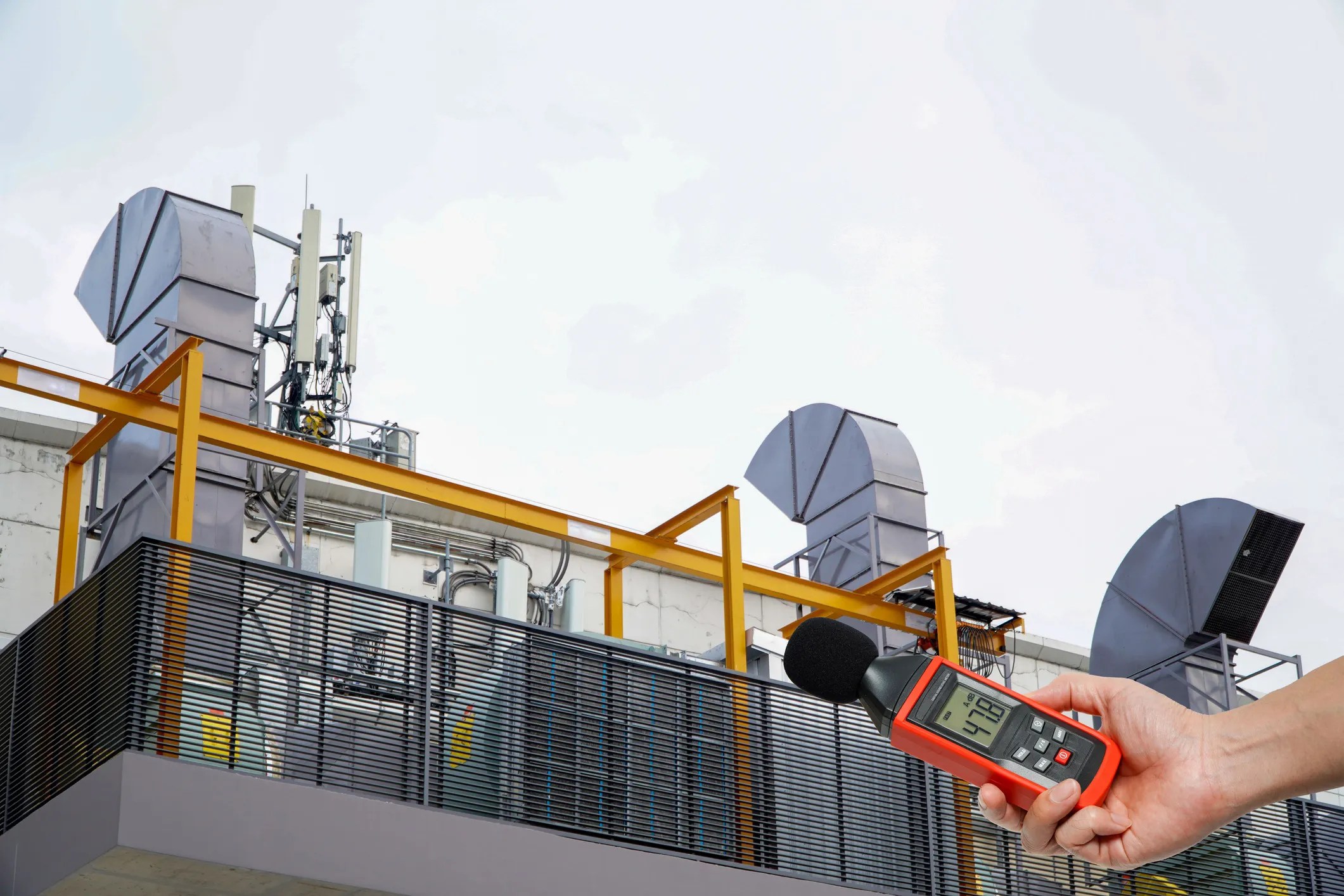
From large-scale industrial and construction equipment to smaller residential appliances, the sound generated by these various products can have significant consequences on health, safety, and quality of life. Prolonged exposure to high noise levels can lead to hearing loss, stress, sleep disturbances, and even cardiovascular issues. As a result, regulatory bodies have established standards for sound power levels in different settings. One such standard is ISO 3744:2025—Acoustics – Determination of sound power levels of noise sources using sound pressure – Engineering methods for an essentially free field over a reflecting plane, which provides procedures for assessing machinery, equipment, and components in less-than-perfect acoustic conditions.
Purpose of Acoustic Testing
Acoustics involves the study of sound, noise, and vibration. Different products have varying acceptable noise levels, so understanding their acoustic performance is important. Acoustic testing evaluates how a product will perform in real-world environments and identifies whether adjustments are needed to minimize noise. It helps diminish high levels of noise from traffic, neighbors, and other sources.
ISO 3744:2025 is an international standard for engineering methods to determine the sound power level of a noise source from sound pressure measurements. It helps quantify noise from machinery, equipment, and installations for product labeling, regulatory compliance, and noise control.
Updates in the 2025 Edition of ISO 3744
The 2025 edition of ISO 3744 clarifies existing procedures, moving some test environment qualification methods to ISO 26101-2, clarifying cylindrical surface measurements, and adding a new Annex I for reducing measurement uncertainty. ISO 3744:2025, however, largely maintains the core measurement process and reproducibility from the 2010 version, and the standard deviation of reproducibility for the main procedure is unchanged.
What Is ISO 3744:2025
ISO 3744:2025 specifies methods for determining the sound power level of a noise source from sound pressure levels measured on a surface enveloping the noise source (machinery or equipment) in an environment that approximates to an acoustic free field near one or more reflecting planes. The sound power level produced by the noise source, in frequency bands or with A-weighting applied, is calculated using those measurements.
In essence, ISO 3744:2025 provides a standardized, practical way for manufacturers and engineers to quantify the noise output of their products in typical operational or semi-controlled environments.
Test Environments in ISO 3744:2025
The test environments that are applicable for measurements made in accordance with ISO 3744:2025 can be located indoors or outdoors, with one or more sound-reflecting planes present on or near which the noise source under test is mounted. The ideal environment is a completely open space with no bounding or reflecting surfaces other than the reflecting plane(s), such as that provided by a qualified hemi-anechoic chamber, but procedures are given for applying corrections (within limits that are specified) in the case of environments that are less than ideal.
Annex A or ISO 26101-2 specifies methods for determining the adequacy of the test environment.
Where to Find ISO 3744:2025
Determining sound power levels in outdoor and indoor spaces is a critical aspect of assuring compliance with regulatory standards. Manufacturers, noise control engineers, and testing labs can use ISO 3744:2025 for industrial machinery, equipment (HVAC, generators), and consumer products (washing machines, tools) to assure regulatory compliance, compare products, and reduce noise.
ISO 3744:2025—Acoustics – Determination of sound power levels of noise sources using sound pressure – Engineering methods for an essentially free field over a reflecting plane is available on the ANSI Webstore.