
Why Does NYC Have So Much Scaffolding?
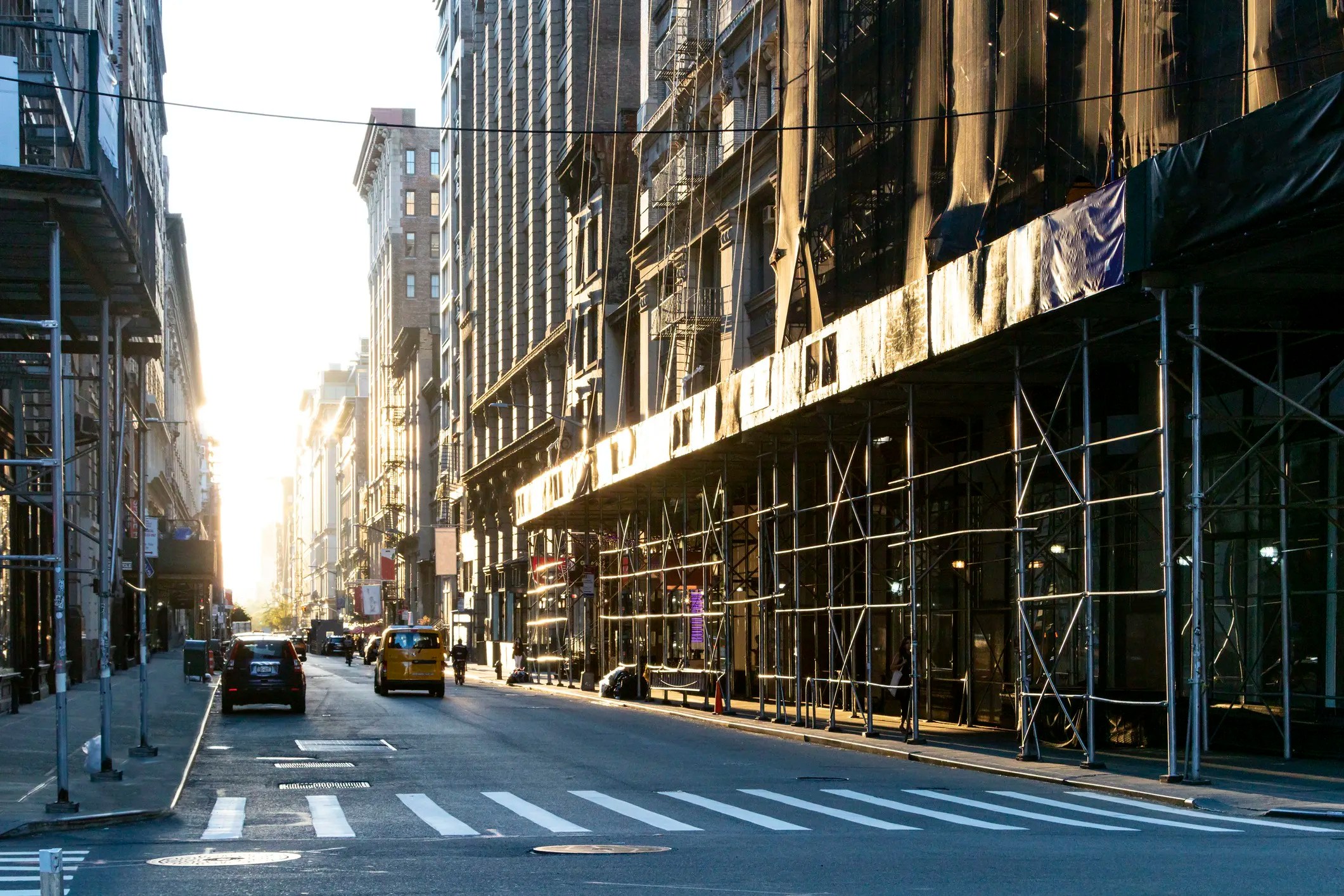
In New York City (NYC), pedestrians hastily come and go, but our daily sightings of scaffolding are here to stay. There are currently over 8,400 scaffolding structures across NYC. While they are meant to be temporary, the average age of scaffolding in NYC is over 500 days old. 334 scaffolding structures have been in place for more than five years. Furthermore, NYC has so much scaffolding — more than 400 miles worth at any given time — mainly because of strict safety laws, delays in completing repairs, and aging buildings.
Difference between Scaffolding and Sidewalk Sheds
Before discussing the proliferation of scaffolding in NYC, it is important to understand how scaffolding differs from sidewalk sheds. While both are temporary structures used in construction, they each serve different purposes and have distinct designs:
- Scaffolding is used primarily as a platform for workers to access and work on a building’s exterior, helping them reach high places safely to perform tasks like painting, repairing windows, or cleaning. Scaffolding basically looks like a metal ladder that surrounds the outside of a building undergoing repairs or renovations.
- Sidewalk sheds are designed to protect pedestrians from falling debris or construction materials. They are essentially temporary roofs made of wood or metal.
In sum, scaffolding helps workers reach high places safely for building repairs, while sidewalk sheds protect pedestrians from falling objects during construction.
Assuring the Safety of Scaffolding for Buildings & Structures
ANSI/ASSP A10.8 is intended to be a guide for contractors, labor, and equipment manufacturers. It is a widely recognized American National Standard that provides detailed guidelines for the safe erection, use, and dismantling of various scaffolding types. ANSI/ASSP A10.8 addresses various types of scaffolds, including suspended scaffolds, system scaffolds, tube and coupler scaffolds, and form and carpenter bracket scaffolds.
You can learn more ANSI/ASSP A10.8 about in our blog post: ANSI/ASSP A10.8-2019: Scaffolding Safety Requirements.
What Sparked the Erection of Sidewalk Sheds in NYC?
In 1979, a piece of terra cotta fell from a building façade on Broadway north of 115th Street, tragically killing 17-year-old Barnard College freshman, Grace Gold. In the wake of this tragedy, laws were enacted that mandated periodic inspection of the facades of buildings taller than six stories. Conducting those inspections requires the erection of scaffolding and protections for people on the surrounding streets and sidewalks. Thus, this tragedy ultimately resulted in the birth of Local Law 10 (1980) and Local Law 11 (1998)—which significantly expanded and strengthened the requirements of Local Law 10.
What Is the Façade Inspection Safety Program (FISP)?
Since 1980, NYC has enforced the Façade Inspection Safety Program (FISP), formerly known as Local Law 11. This law mandates that buildings in NYC (Manhattan, the Bronx, Brooklyn, Queen, and Staten Island) over six stories be inspected every five years for facade safety. If there is any risk of falling debris (e.g., loose bricks or crumbling masonry) found, the building owner must install scaffolding immediately to protect pedestrians — even before repairs begin. As such, this legal requirement alone accounts for a significant portion (i.e., over 8,400 scaffolding structures) of the scaffolding around NYC.
Inspections Under FISP
Inspections under FISP are performed by Qualified Exterior Wall Inspectors (QEWI), who categorize buildings in one of the three categories: Safe, SWARMP (Safe with a Repair and Maintenance Program), or Unsafe. Depending on the building’s status, any deficiencies must be corrected in an allotted period of time. Any Unsafe conditions observed by a QEWI must be immediately reported to the Department of Buildings (DOB) via a Notification of Unsafe Conditions—known as a FISP3 form. Submission of a FISP3 triggers a violation, and a DOB representative often inspects the Unsafe conditions within 24 hours of notification. Lastly, if a building’s façade is found to be unsafe, the building owner must erect scaffolding immediately to protect pedestrians.
After an Unsafe Report, the owner or manager has a couple options: 1) complete the required repairs within 30 days, or 2) where 30 days is not a sufficient amount of time to complete the work (as is most often the case), submit to the DOB an extension request. As long as adequate safety measures are in place and an appropriate repair timetable is established, the DOB typically grants a 90-day extension. Additional extensions can then be requested and granted every 90 days as needed, until the work is completed. As long as extensions are approved and maintained during the repair program, the DOB will not assess any fines.

Why Does NYC Scaffolding Stay Up So Long?
Under FISP, scaffolding and sidewalk sheds installed for façade repairs are intended to stay up only for the duration of the necessary repairs; however, they often remain in place for much longer due to delays in completing the work. Variables like obtaining permits, getting approval from a building’s stakeholders, bad weather, and waiting on reviews from the city can elongate the repair process.
Additionally, as long as the scaffolding stays in place to prevent injuries, there is no deadline for completing the repairs. As a result, some scaffolds stay up for years, even over a decade; about 1.9k sidewalk sheds have stood for at least two years, and more than 300 have stood for at least five years. Scaffolding stays up for so long often because some building owners find that it is cheaper in the short term to keep paying to rent scaffolding (a few thousand per month), instead of spending hundreds of thousands on repairs.
Historical Perseveration Efforts of Aging Buildings in NYC
NYC is an evolving metropolis, home to many historic buildings that require ongoing maintenance and restoration. These preservation efforts often involve the use of scaffolding to access and repair the intricate details of these aging structures like the Flatiron Building, Empire State Building, and Chrysler Tower. While scaffolding may be an eyesore, it is fundamental to preserving NYC’s architectural legacy and unique character.
ISO 13822 is applicable to assessing the structural integrity of historical or culturally significant buildings. It provides a basis for the design of structures and includes provisions for assessing existing structures. This is an important step in any preservation effort for engineers and clients, who need to assess the reliability and safety of existing structures.



I am from Australia and I didn’t know why there was so much scaffolding and a lot looked like it had been there for a longtime. A bit disappointing to see most street’s with it and ruins the aesthetics of the city.
I lived in the city in the 80s and 90s, and visit often now. The scaffolding and sidewalk sheds have always been a sad sight and far as I can tell more of a problem for pedestrians. I hope the new administration can make some needed changes.