


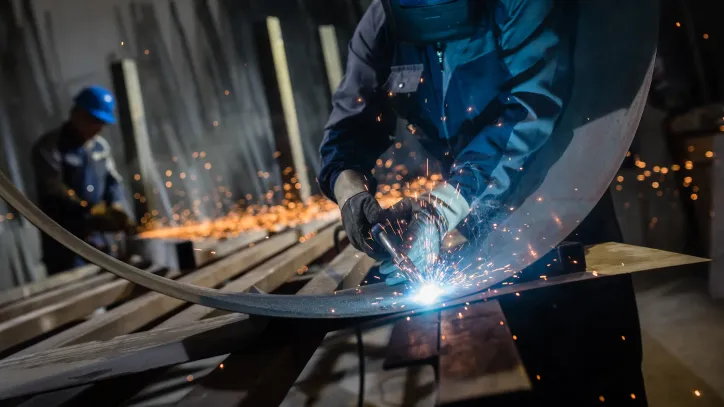
Besides its dependability in structural applications, sheet metal is a component in heating, ventilation, and air conditioning systems and food processing equipment. As the material is ideal for so many purposes, one thing is clear: sheet metal influences the simplicity and dependability that makes our lives easier.
Other than the extrusion of the materials, sheet metals are crafted into product design largely through welding processes. AWS D9.1/D9.1M:2026, Sheet Metal Welding Code offers guidelines for sheet metal welding to keep practices shared and sufficient.
What Is AWS D9.1:2026?
AWS D9.1:2026 provides qualification, workmanship, and inspection guidelines that apply to the fabrication, manufacture, and erection of nonstructural sheet metal components and systems.
AWS D9.1:2026 covers sheet metal thickness up to and including 3 gauge or 0.250 in (6.4 mm). It also is used for the attachment of accessories and components of the system and the joining or attachment of members for stiffening, supporting, or reinforcing the sheet metal.
As it covers both arc welding—the joining of metals by melting and intermixing the joint between two parts—and braze welding—heating and melting a filler alloy that bonds to the two pieces of metal and joins them—AWS D9.1:2026 is broken up into two primary parts: Part A, Arc Welding and Part B, Braze Welding. In addition to detailing the general provisions for each of these, the standard covers the procedure, workmanship, inspection, and qualification of the welders and welding operators.
Please note that AWS D9.1:2026 is not intended to apply where negative or positive pressure exceeds 5 psi or when automotive applications are concerned. It also does not apply where brazing applications are specified to be in accordance with AWS B2.2 or where soldering applications are specified to be in accordance with AWS B2.3.
Furthermore, while sheet metal does often meet structural demands, sheet metal subject to structural requirements should adhere to AWS D1.3/D1.3M:2025, Structural Welding Code – Sheet Steel.
Changes to AWS D9.1:2026
AWS D9.1:2026 is the eighth edition of the sheet metal welding code, and it revises and supersedes the 2018 version of the same standard. This revision provides for the maintenance of the document, updates to provide clarity, and to promote a minimum quality level for those that invoke it.
The changes made to this standard can be identified easily in the standard document, where they are clearly marked. Some of the primary updates to AWS D9.1:2026 include:
- Sheet metal thickness covered by the code was changed to up to and including 3 gauge or 0.250 in [6.4 mm] (previously 0.2391 in [6.07 mm]).
- New definitions added for coating and weld metal grade.
- Previous sections on “Welding Current,” were retitled “Electrical Characteristics” and merged with the revised content of former “GMAW Mode of Transfer” sections in 5, “Arc Welding Procedure Qualification,” 6, “Qualification of Arc Welders and Arc Welding Operators,” 10, “Braze Welding Procedure Qualification,” and 11, “Qualification of Braze Welders and Braze Welding Operators.”
- New Table 1, “Mixture Tolerances,” was added to 5.3.8, “Shielding Gas.”
- Clarifications were added to 5.4.1, “Groove Welds,” and 5.4.2, “Fillet Welds.”
- Section 8, “Inspection of Production Arc Welding Work,” and Section 13, Inspection of Production Braze Welding Work,” were revised to cover the Qualification of inspection personnel, including the basis for qualification of welding inspectors, eye examination, term of effectiveness, inspector responsibility, and items to be furnished to the inspector.
Commentary on AWS D9.1/AWS D9.1M:2026
This revision also sees the first publication of the Commentary on Sheet Metal Code, which was added to the end of the AWS D9.1:2026 document. Since the code itself is written in the form of a specification, it cannot present background material or explain the intent of the Sheet Metal Committee. This commentary explains the basis for code provisions and details enough information to help those in the sheet metal industry use the code effectively.
Suggestions for application as well as clarification of code requirements are provided in the commentary. Furthermore, to assist past users of the code, the commentary places a specific emphasis on new or revised sections that may be less familiar to the user.
AWS D9.1/D9.1M:2026, Sheet Metal Welding Code is available on the ANSI Webstore.
Questions About AWS D9.1:2026?
AWS D9.1 was developed by the American Welding Society.
Please direct any technical questions relating to this American National Standard to the developer. You can find the contact information for all ANSI-accredited standards developers here: List of ANSI-Accredited Standards Developers (ASDs).
For further information, please refer to: Who to Contact for Standards Related Questions.