


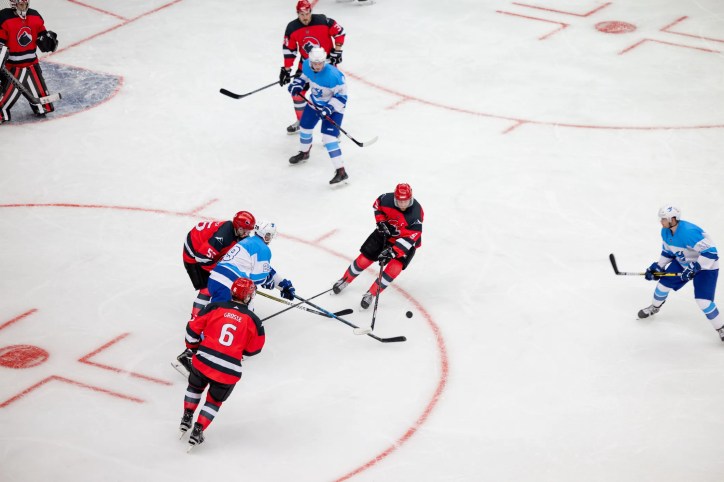
Protective equipment in ice hockey enables players to move without hesitation, lean into a check, block a shot, and dive across the crease with complete commitment. Shoulder pads, shin guards, and facial protection absorb forces the human body was never meant to withstand alone, allowing athletes to remain fully present in the game instead of calculating the cost of every impact. Behind this physical protection is ISO 10256-1:2024—Protective equipment for use in ice hockey – Part 1: General requirements: an international standard specifying general safety, ergonomic, and testing requirements for protective equipment used in ice hockey.
Evolution of Ice Hockey Protective Equipment: From Early Gear to ISO 10256-1:2024
The first organized ice hockey game took place in Montreal in 1875. Players wore rudimentary skates strapped to leather boots and played with wooden hockey sticks and a wooden puck. They donned heavy woolen turtleneck sweaters, football pants, knee-high socks, and gloves to stay warm, with no other gear. Some of the earliest protective equipment in hockey were homemade shin guards in the 1880s, crafted from strips of leather strengthened with pieces of wood. Soon after, goaltenders began strapping cricket pads to their legs to shield themselves from fast-moving pucks.
By the early 1900s, hockey equipment began evolving quickly, largely in response to player injuries. Elbow pads were introduced to prevent fractures from falls, while gloves were redesigned with added padding and reinforced wrists for better protection. Players also began wearing knee-high padded pants supported by suspenders—a design that continues to influence modern equipment today.
A major turning point came in 1933 when Ace Bailey suffered a severe head injury during a game between the Toronto Maple Leafs and the Boston Bruins, helping drive the eventual adoption of helmets, which the National Hockey League mandated in 1979. Furthermore, face injuries were once common for goaltenders until Montreal Canadians goaltender Jacques Plante advanced ice hockey safety in 1959 by introducing the protective mask.
After World War II, hockey’s growing popularity and television exposure led to equipment in the National Hockey League (NHL) being standardized, with new materials like plastics and fiberglass making gear lighter, safer, and more effective. At the same time, traditional wool sweaters evolved into lightweight, breathable jerseys with features like fight straps, protecting players while supporting faster, more dynamic performance.
Today, modern ice hockey equipment is carefully engineered to assure that players can perform at high levels while reducing the risk of severe injury—an effort reinforced by standards such as ISO 10256-1:2024.
What Is ISO 10256-1:2024?
ISO 10256-1:2024 specifies general requirements and test methods for head, face, eye, neck, and body protectors for use in ice hockey. It outlines methods for testing, marking, and providing user information to assure products are safe and fit for purpose. This international standard is essential for assuring that equipment meets safety standards in the high-speed collision sport of ice hockey.
Importance of Protective Equipment in Ice Hockey
Ice hockey protective equipment—including helmets, face masks, neck guards, and pads—is essential to reduce the frequency and severity of injuries. ISO 10256-1:2024 notes that the protective function is intended to distribute and dampen the force of impact and to counteract the penetration of objects applied to the protector, and in the case of neck protectors, reduce the risk of lacerations.
Where to Find ISO 10256-1:2024
Manufacturers, testing labs, certification bodies, and sports organizations can use ISO 10256-1:2024 to assure ice hockey protective equipment (helmets, face, eye, neck, and body guards) meets safety, ergonomic, and performance standards.
ISO 10256-1:2024—Protective equipment for use in ice hockey – Part 1: General requirements is available on the ANSI Webstore.