


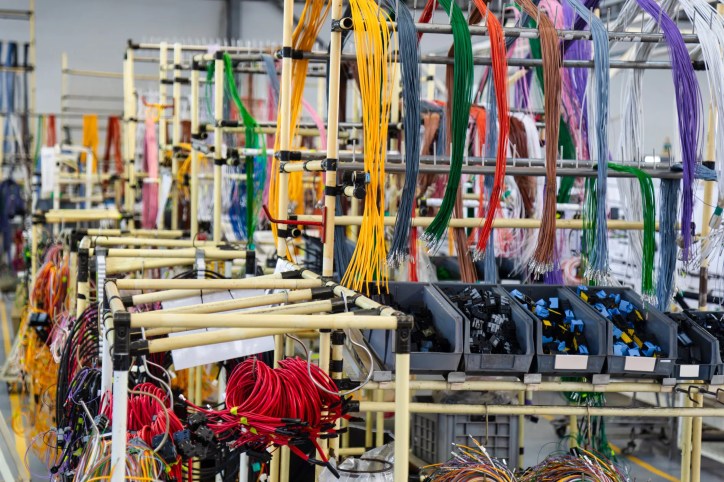
Both wire harness and cable assemblies provide electrical connectivity while keeping wires and cables organized and consolidated. These systems transmit signals or electrical power in most automobiles and airplanes. IPC/WHMA A-620F-2025: Requirements And Acceptance For Cable And Wire Harness Assemblies specifies requirements for producing crimped, mechanically secured and soldered interconnections for cable and wire harness assemblies.
Wire Harness vs Cable Assembly
The terms wire harness and cable assembly are often used interchangeably, but wires and cables are not the same.
What Is a Wire Harness?
A wire is a single strand of a conductive material like tin or copper that conducts electricity. The wire harness keeps the electric cables and wires organized via bundling them together. It offers a cover that encases single cables, usually from the same material utilized in a cable assembly. Wire harnesses cannot shield wires from extreme temperatures or friction between one another, so they are fundamentally used for indoor use and are present in most automobiles and planes.
Many of our everyday household products like computers, televisions, monitors, microwaves, and refrigerators use wire harnesses. These products use wire harnesses rather than of cable assemblies because these products come with a protective shell, which removes the requirement for added protection.
What Is a Cable Assembly?
A cable is a bundle of wires twisted or braided together that is contained within a single protective outer sheath, coming together as only one thick wire. Cable assemblies thereby offer more vigorous protection by keeping components snug within a rugged outer sheath. They guard all the products safe in the most extreme environmental conditions and temperature changing, making them ideal for outdoor use.
Cables assemblies offer a high-level resistance to outside variables (e.g., heat, dust, and moisture) and protect the wire and cables from friction and corrosion. Many heavy industries like medical, military, aerospace, and construction generally use cable assemblies in their manufacturing processes since they are great for high-speed data transfers.
Changes in the 2025 Edition of IPC/WHMA A-620
IPC/WHMA A-620F-2025 is the newest version of the standard, incorporating feedback and technological advancements since edition E (released Oct 2022). The progression from E to F means that edition F contains the most current, essential criteria for quality workmanship. In other words, the A-620F document officially replaces and makes the A-620E version obsolete as the current standard.
The “F” edition includes updates and changes to the standard for requirements and acceptance of cable and wire harness assemblies, reflecting the latest industry consensus and technological advancements. This new edition strengthens guidance across key areas, including classification, inspection methodology, process control, soldered and crimped terminations, protective coverings and testing.
What Is IPC/WHMA A-620F?
IPC/WHMA A-620F-2025 provides a common language for cable and wire harness manufacturing. It is the only industry-consensus standard for Requirements and Acceptance of Cable and Wire Harness Assemblies. The document describes materials, methods, tests and acceptance criteria for producing crimped, mechanically secured and soldered interconnections and the related assembly activities associated with cable and harness assemblies. These assembly activities include:
- Testing
- Cable and wire preparation
- Wire stripping
- Discrete wire termination
- Soldering
- Molding
- Potting
- Mechanical interconnections
- Labeling
The intent of IPC/WHMA A-620F-2025 is to rely on process control methodology to assure consistent quality levels during the manufacture of products.
This standard does not provide criteria for cross-section or X-ray evaluation.
Using IPC/WHMA A-620F
The use of IPC/WHMA A-620F-2025 requires agreement on the Class to which the product belongs. The user (or the manufacturer) has the ultimate responsibility for identifying the Class to which the assembly is evaluated.. Criteria defined in this standard reflect three Product Classes:
- Class 1 General Electronic Products: Includes products suitable for applications where the major requirement is the function of the completed assembly.
- Class 2 Dedicated Service Electronic Products: Includes products where continued performance and extended life is required, and for which uninterrupted service is desired but not critical. Typically, the end-use environment would not cause failures.
- Class 3 High Performance/Harsh Environment Electronic Products: Includes products where continued performance or performance-on-demand is critical, equipment downtime cannot be tolerated, end-use environment may be uncommonly harsh, and the equipment must function when required, such as life support systems and other critical systems.
What Industries Use Cable and Wire Harness Assemblies?
Wiring harnesses and cable assemblies solve many challenges associated with complex electrical systems. Since they are custom designed, they can dramatically improve a systems efficiency. These assemblies are used in many kinds of equipment among diverse industries to deliver electronic signals in that system:
- Aerospace: Cable and wire harnesses enable power transmission in aircraft engines, data transmission from satellites, and space force systems.
- Automotive: Makes extensive use of wiring harnesses and cable assemblies, including in both gasoline and electrical vehicles. This includes the vehicle’s battery, the main control unit, and turn signals, displays.
- Medical: Cable and wire harnesses enable rapid links, keeping patients safe, and are installed in installations like imaging equipment, MRI machines, x-rays, electronic beds, and dental chairs.
- Telecommunications: include anywhere from tens to thousands of cables, all of which must be organized to save space and facilitate identification. Assemblies serve this role, bundling cables for modems, routers, and similar communication equipment.
- Information Technology: wire harnesses and cable assemblies save space within small laptops and organize the thousands of cables within a networking facility.
- Construction: Harnesses to insulate and organize electrical wiring in compliance with all relevant codes in residential and commercial buildings.
- Manufacturing: Harnesses keep facilities safe by containing wiring and ensuring connections are reliable in machines like CNC units, 3D printers, and conventional workstations that all require extensive wiring.
- Robotics and Automation: Require organized (often the space is limited) and durable wiring to function properly, so harnesses are needed to route and contain circuits.
Where to Find IPC/WHMA A-620F
By clearly defining materials, workmanship, and acceptance criteria, IPC/WHMA A-620F-2025 helps assure that assemblies are built consistently across different suppliers and industries. For manufacturers, following this standard helps streamlines training, inspection, and documentation, making it easier to meet customer requirements and regulatory demands.
IPC/WHMA A-620F-2025: Requirements And Acceptance For Cable And Wire Harness Assemblies is available on the ANSI Webstore.