


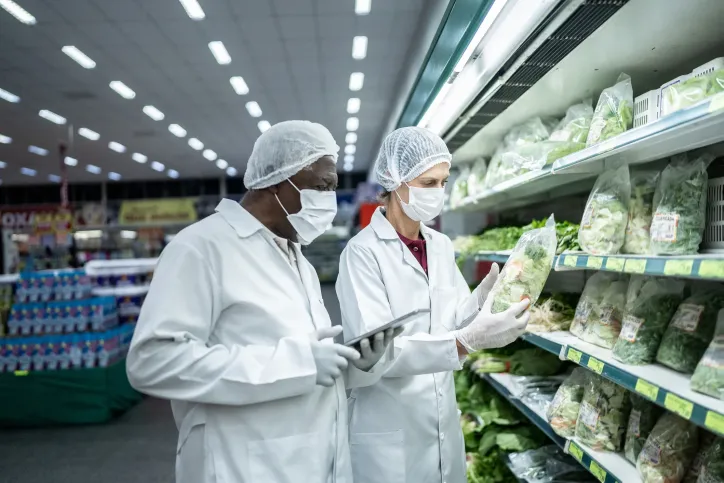
The United States food safety system is often described as one of the most advanced in the world, but beneath the surface, it is highly fragmented. Oversight is split across agencies like the Food and Drug Administration (FDA) and the US Department of Agriculture (USDA), creating a patchwork of rules, delays, and blind spots. This fragmentation of the U.S. food supply system contributes to inconsistent regulations, ineffective coordination, and delayed outbreak detection. Fortunately, ISO 22000 offers a more unified, globally recognized approach to managing these risks across the entire supply chain.
Food Safety in the U.S.
Foodborne illness is a major public health issue: about 48 million people in the U.S. (1 in 6) get sick, 128,000 are hospitalized, and 3,000 die each year from foodborne diseases, according to recent data from the Centers for Disease Control and Prevention. Furthermore, the Government Accountability Office says it costs Americans an estimated $75 billion a year in medical care, lost productivity and premature deaths.
Key Obstacles with U.S. Food Safety System
Key obstacles with the U.S. food safety system include insufficient resources, slow implementation of preventive measures, delayed gaps in public awareness of recalled items, and limited inspection capacity, allowing contaminated food products to reach consumers.
Fragmented Oversight Across Agencies
US food safety oversight is highly fragmented across federal, state, and local jurisdictions. It consists of over 15 federal agencies—primarily the U.S. Department of Agriculture (USDA) and Food and Drug Administration (FDA). The FDA regulates most foods (produce, seafood, packaged goods); the USDA oversees meat, poultry, and some egg products. Besides federal agencies, responsibility for oversight is divided among 75 state entities and thousands of local jurisdictions, operating under more than 30 laws and 70 interagency agreements.
Reactive Rather Than Preventive System
Although the Food Safety Modernization Act (FSMA) aimed to shift toward prevention, many aspects of the system still rely on responding to outbreaks after they occur. For example, outbreak investigations often happen after widespread exposure, and food recalls frequently occur only once illnesses are reported (a study analyzing food safety data from 2006–2016 found that 48% of recall-associated outbreaks occurred after the outbreak was detected).
Recent reporting shows that outbreaks can sicken dozens before action is taken, highlighting delays in detection and response. For example, a report from the U.S. Public Interest Research Group (PIRG) reviewed 28 foodborne illness outbreaks in 2025 (linked to over 1,000 illnesses) and found that 17 of them did not result in a publicly announced recall, even when a specific product was identified. One major issue highlighted is delayed communication as investigations can take months or even years, meaning consumers may unknowingly continue buying or consuming unsafe food.
Rising Food Recalls and Outbreaks in the U.S.
The FDA issued 571 recalls in 2025, which is up 15.4% from the year prior. Total units involved surged 209% to 138.5 million, largely driven by bacterial contamination (96.4M units) and undeclared allergens—often resulting from labeling or packaging mistakes.
Delayed Gaps in Public Awareness
In some outbreak investigations, regulators do not immediately disclose the source of contamination, especially if products are no longer on the market. Withholding information about suppliers or retail locations until investigations are finalized can delay public awareness, leaving tainted products in consumer homes. Additionally, it makes it harder to prevent repeated incidents as demonstrated in the recurring E. coli O157:H7 outbreaks linked to leafy greens, which have sickened thousands over decades.
Limited Inspection Capacity
Inspection is a cornerstone of food safety, but resources are strained. Imported foods constitute a significant and growing share of the U.S. food supply, with roughly 15-17% of total food and beverages imported. Imports account for approximately 60% of fresh fruit, 38-40% of fresh vegetables, and over 90% of seafood consumed annually, driven by consumer demand for year-round availability. Furthermore, imported foods are increasingly linked to foodborne illness outbreaks in the U.S., particularly with fresh produce and seafood from Latin America, the Caribbean, and Asia. Common pathogens include Salmonella, Cyclospora, and E. coli, often linked to contaminated cucumbers, spices, and leafy greens.
Inspection rates for foreign facilities have declined in some periods due to staffing and funding challenges. As of July 2025, foreign food inspections dropped nearly 30% compared to previous years.
Importance of Food Safety
Food safety is not just a regulatory issue; it is a public health imperative. Vulnerable populations, including children, older adults, and immunocompromised individuals, face the greatest risk of severe illness or death. As such, implementing and adhering to food safety standards like those detailed in ISO 22000 are essential to assure safe food production, enhance stakeholder trust, and assure compliance in the global supply chain.
Who Uses ISO 22000?
ISO 22000 is used by any organization (regardless of size or complexity) within the food chain—from farmers to caterers—to build a comprehensive Food Safety Management System (FSMS). Key users include agricultural producers, food manufacturers, packaging producers, transportation/warehousing providers, retailers, and food service operators (restaurants/caterers).
Why Adhering to ISO 22000 Matters for US Food Safety
While U.S. food safety is primarily governed by federal regulations like the Food Safety Modernization Act (FSMA), international standards such as ISO 22000 play an increasingly important role in strengthening the system, especially in a globalized supply chain. ISO 22000 provides a comprehensive framework for food safety management systems that integrates hazard analysis, critical control points (HACCP), and risk-based thinking across the entire food chain.
ISO 22000 emphasizes end-to-end coordination, requiring organizations to identify, control, and continuously monitor food safety hazards at every stage. This is particularly critical given that the U.S. imports about 15% of its food supply. This reliance includes roughly 94% of seafood, 55% of fresh fruit, and 32% of fresh vegetables.
Companies operating internationally (or supplying imported goods) often adopt ISO 22000 to align with global expectations and improve traceability, transparency, and accountability. While not mandatory in the U.S., the adoption of ISO 22000 can help fill regulatory gaps by creating a more unified, preventive, and globally consistent approach to food safety.
Where to Find ISO 22000
ISO 22000:2018 Food safety management systems – Requirements for any organization in the food chain is available on the ANSI Webstore and in the Standards Packages: