


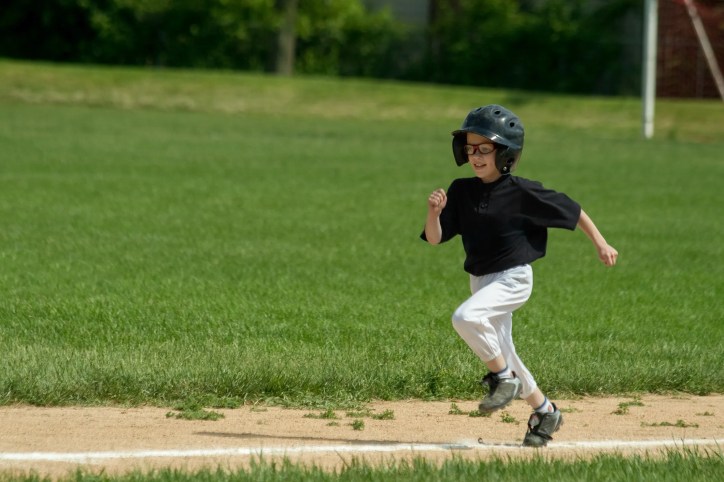
As the crowd roars, you signal to your teammate, eyes locked on the ball, ready to make your move. But suddenly, a fast-moving basketball strikes into your face. In a split second, your vision could be compromised forever. Each year, nearly 30,000 athletes in the U.S. experience a sports-related eye injury. Basketballs, baseballs, and air guns are responsible for almost half of these injuries. What was meant to be fun, exhilarating, and full of adrenaline, can so easily become the moment an athlete’s future vision is shattered. However, this does not have to be the case. As the safety standard for protective sports eyewear, ASTM F803-25: Standard Specification for Eye Protectors for Selected Sports establishes specifications for rigorous, high-velocity impact testing to prevent eye injuries.
Preventing Sports-Related Eye Injuries: The Risk of Permanent Damage in Intense Competition
Sports-related eye injuries are a significant concern that can have serious, long-lasting consequences. These eye injuries range from minor abrasions and bruising to more severe conditions, such as retinal damage, detached retinas, or even permanent vision loss. What makes these injuries particularly alarming is their unpredictability as athletes of all ages and skill levels can be affected, often in an instant, during the heat of an intense competition. While the basketball, baseball, or racquetball may be rapidly moving, the consequences of a split-second injury can last a life time.
High-Risk Sports and the Importance of Proper Eye Protection
Basketball leads the list of sports causing eye injuries in the U.S., followed closely by baseball, softball, airsoft rifles, pellet guns, racquetball, and hockey. The risk is high in these sports where high-velocity objects, like basketballs, baseballs, or racquets, are in constant motion. Even seemingly minor contact like a fingernail scratch or blunt impact from a ball or elbow can lead to irreversible damage, making it essential for athletes to take the necessary precautions to protect their eyes. It is therefore crucial to wear proper eye protection in high-risk sports to prevent these potentially devastating injuries. In fact, an estimated 90% of eye injuries during sports could be prevented with the right precautions.
ASTM F803-25 covers requirements for protective sports eyewear and is designed to minimize eye injuries, such as orbital fractures or blindness, in high-impact sports like basketball, soccer, and racquetball.
What Is ASTM F803-25?
ASTM F803-25 covers eye protectors, designed for use by players of basketball, baseball, and soccer to minimize or significantly reduce injury to the eye and adnexa due to impact and penetration by baseballs and softballs, basketballs, soccer balls, hands, elbows, and fingers.
This specification applies to eye protectors for use by wearers of corrective lenses and also by those players who do not require prescription eyewear. (Warning—Polycarbonate or Trivex spectacle lenses should be used if spectacles are worn under protective eyewear.)
Protective eyewear offers protection only to the eyes and adnexa and does not protect other parts of the head.
ASTM F803-25 details that materials should be tested using optical tests such as field of view, optical quality, luminous transmittance, prismatic deviation measurements, haze, refractive power measurements, surface imperfections and internal defects, and alternate optical tests; and mechanical tests such as high velocity impact resistance, and projectile simulator test. In addition, the individual grades should conform to the general, and performance requirements.
Types of Protectors in ASTM F803-25
Depending on their design characteristics, ASTM F803-25 details protectors are divided into the following types:
- Type I—A protector with the lens or lenses and frame front piece molded as one unit. Frame temples or other devices, such as straps, to affix the lens/front piece may be separate pieces.
- Type II—A protector with a single lens or lenses, either plano or prescription, mounted in a frame that was manufactured as a separate unit.
- Type III—A protector without a lens.
- Type IV—A full or partial face shield.
Type IV protectors, full or partial face shields, should conform to the optical requirements of ASTM F1776-25: Standard Specification for Eye, Face, and Head Protective Devices for Paintball Sports.
Where to Find ASTM F803-25
Choose eye protection that meets ASTM F803-25 requirements. ASTM F803-25: Standard Specification for Eye Protectors for Selected Sports is available on the ANSI Webstore