


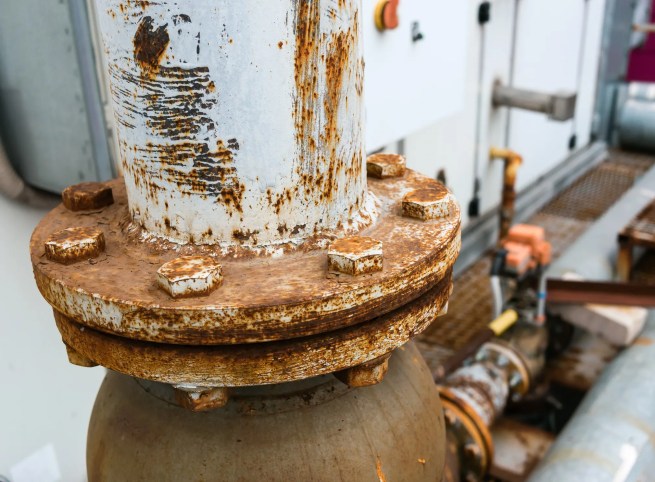
Even the most durable or permanent items can at some point deteriorate. That doesn’t mean these qualities should be ignored. However, the ability to remain unchanged is a property that should be discerned and actively endeavored to maintain. ASTM B117-25: Standard Practice for Operating Salt Spray (Fog) Apparatus provides guidelines for an apparatus that is helpful in discerning corrosion resistance information.
What Is Corrosion?
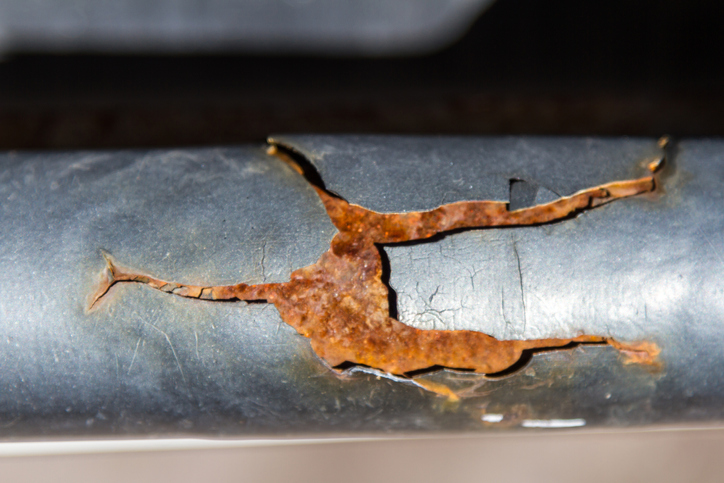
Corrosion is the decay of a material due to the chemical reaction with its environment. When a significant number of atoms on a metallic surface are oxidized, general corrosion occurs. The most familiar corrosion product of iron is rust. Corrosion remains a significant challenge for any industry (e.g., including oil & gas, maritime, water/wastewater, power generation, civil infrastructure, manufacturing, automotive, and aerospace) that uses metallic substrates.
What Are the Effects of Corrosion?
Corrosion can compromise the safety of human life. Numerous tragedies have resulted due to corrosion. For example, in 2017, a ride collapsed at an Ohio state fair, killing one and injuring seven others. The manufacturer cited corrosion as the reason for ride failure. In 1983, the Mianus River Bridge collapsed, killing three people and seriously injuring others. The bridge was only 25 years old at the time. Investigations found that the support pins in the bridge had corroded.
Corrosion can also be expensive. A NACE International study conducted from 1999 to 2001 found that corrosion directly cost the US $276 billion annually. This of course does not take into account the indirect cost of corrosion. According to the same NACE study, the indirect cost was conservatively estimated to be a total of $552 billion. Clearly, corrosion demands consideration.

Purpose of Salt Spray (Fog) Testing
Salt spray (fog) testing is a method designed to provide a controlled corrosive environment using a salt fog chamber to evaluate the corrosion resistance of metallic and nonmetallic coated metal substrates. Its purpose is to accelerate corrosion in a controlled environment to evaluate the corrosion resistance and durability of materials and surface coatings, simulating harsh, salty conditions like marine or industrial exposure for industries such as automotive, aerospace, and construction.
Salt spray (fog) testing helps determine product quality, compare coating effectiveness, identify potential failures early (saving costs) and assure compliance with standards like ASTM B117-25.
What Are the Changes in the 2025 Edition of ASTM B117?
The 2025 edition of the ASTM B117 standard, designated ASTM B117-25, is the current version and it continues to be a standard practice for operating salt spray (fog) apparatus. ASTM B117-25 includes editorial and minor technical clarifications, such as updating referenced water standards and modernizing a technical drawing. But, there are no fundamental changes to the core salt spray test method, temperature, or salt concentration parameters that have been in place for decades.
What Is ASTM B117-25: The Standard Practice for Operating Salt Spray (Fog) Apparatus?
ASTM B117-25 covers the apparatus, procedure, and guidelines to create and sustain the salt spray (fog) test environment. It defines the procedures for operating a salt spray (fog) apparatus to test the corrosion resistance of materials by exposing them to a continuous, controlled salt mist in a chamber. It delivers a controlled corrosive environment that can be used to gather information on relative corrosion resistance for metal specimens and coated metals exposed in a fixed test chamber.
ASTM B117-25 is a widely used benchmark for simulating harsh, corrosive environments (like coastal or road salt conditions) to evaluate metallic products and coatings, though it is important to note that the standard does not prescribe the interpretation of the results. It also does not prescribe the exposure periods to be used for the specific products or the type of test specimen.
Referenced Standard Documents in ASTM B117-25
The referenced documents in ASTM B117-25 include:
- ASTM B368: Test Method for Copper-Accelerated Acetic Acid-Salt Spray (Fog) Testing (CASS Test)
- ASTM D609: Practice for Preparation of Cold-Rolled Steel Panels for Testing Paint, Varnish, Conversion Coatings, and Related Coating Products
- ASTM D1193: Specification for Reagent Water
- ASTM D1654: Test Method for Evaluation of Painted or Coated Specimens Subjected to Corrosive Environments
- ASTM E70: Test Method for pH of Aqueous Solutions With the Glass Electrode
- ASTM E691: Practice for Conducting an Interlaboratory Study to Determine the Precision of a Test Method G85 Practice for Modified Salt Spray (Fog) Testing
- ASTM G85-19: Standard Practice For Modified Salt Spray (Fog) Testing
Where to Find ASTM B117-25
ASTM B117-25 is commonly used across industries to assess the corrosion resistance of metal parts and coatings. This standard is crucial for sectors like automotive, aerospace, marine, construction, electronics, and medical devices, assuring products such as car parts, aircraft components, fasteners, and pipes can endure harsh, salt-laden environments.
ASTM B117-25: Standard Practice for Operating Salt Spray (Fog) Apparatus is available on the ANSI Webstore.