


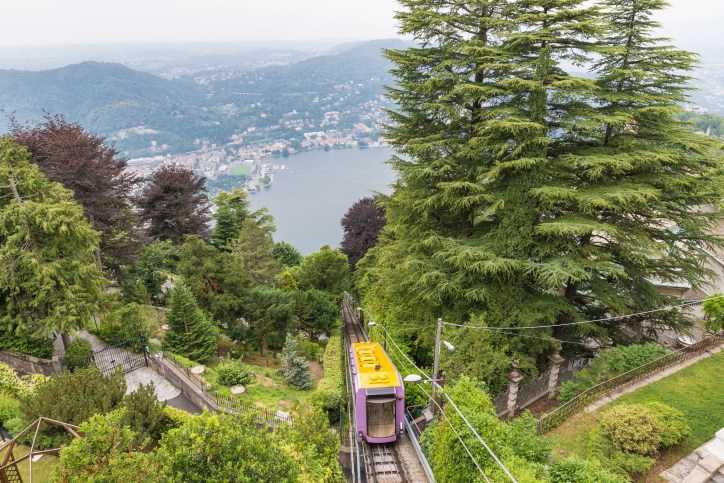
In cities and scenic landscapes, funiculars transformed daunting slopes into accessible pathways, blending mechanical ingenuity with breathtaking views. Devised in the 15th century as a way of getting people and goods up steep hillsides to their present-day more advanced designs, funiculars have remained a striking example of how simple physics and thoughtful engineering can conquer even the steepest terrain. ANSI B77.2-2025: Funiculars – Safety Requirements provides guidance on the safe design of funiculars.
What Are Funiculars?
Funiculars are unique cable railways that use a counterweight system (i.e., a dynamic, two-car system where the descending car acts as a weight to help pull the ascending car up the slope) to transport passengers up or down extremely steep inclines. By using a counterweight pulley system, the funicular uses the kinetic energy of the descending car to raise the ascending car in a manner like that of an elevator.
What Is ANSI B77.2-2025?
ANSI B77.2-2025 establishes guidelines for the design, manufacture, construction, operation, and maintenance of funiculars for passenger transport. The purpose of this American National Standard is to develop a system of principles, specifications, and performance criteria that will meet the following objectives:
- Reflect current state-of-the-art for funicular design, operation, and maintenance
- Be acceptable for adoption by government agencies and others
ANSI B77.2-2025 is intended to result in funiculars that are designed, constructed, operated, and maintained in a manner that helps reduce danger, exposure to risk to passengers and maintenance and operational personnel, and to encourage improvements in productivity, efficiency, development, and progress consistent with the objectives.
History of Funiculars
The history of the funicular stretches back centuries, long before modern railways standardized transportation. One of the most compelling examples comes from Hohensalzburg Fortress, where the Reisszug—first documented in 1515 but historians speculate it could have been in existence as early as 1495—was used to haul goods and people up steep defensive walls using hemp ropes and human or animal power.
Often considered the oldest known cable railway still in operation, the Reisszug demonstrates how early engineers used simple counterweight and pulley concepts to overcome extreme inclines. Centuries later, the nearby Festungsbahn (opened in 1892) modernized this idea for passenger travel, initially using a water-balance system before transitioning to electric power.
Today, modern funiculars continue to adhere to the safety specifications of ANSI B77.2-2025, while maintaining the same core principle that has powered them for over a century: efficient, cable-based, and sustainable transport on extreme inclines.
How Funiculars Work: A Sustainable Engineering Solution for Steep Transport
Funiculars combine simplicity with efficiency, making them a sustainable solution for steep inclines. Rather than relying on fuel, these systems harness the natural energy created by motion through a counterweight design: two cars are connected by a single steel cable that loops around a large pulley (sheave) at the top station. As one car descends, its weight helps pull the other upward, minimizing external energy needs aside from overcoming friction. This balance of forces not only enables smooth, controlled movement on steep slopes where traditional trains would fail, but also highlights why funiculars remain a lasting example of efficient, low-energy transportation engineering.
Characteristics of Funiculars
Funiculars are passenger transportation systems that use wire ropes to provide motion to the carriers that ride on rails or are contained by a guideway. Several names are used regionally to identify these systems (i.e., cable railways, inclines, planes), but ANSI B77.2-2025 details that are all considered funiculars. The standard further specifies that funiculars typically have the following characteristics:
- Carrier capacity over 20 passengers
- Maximum operating speed over 300 feet per minute (1.5 meters per second)
- Complex guideway that may contain curves, variable inclinations and a passing zone
- Direct operator supervision
Where to Find ANSI B77.2-2025
The next time you glide up a steep hillside in a funicular, remember that ANSI B77.2-2025 assures every journey is as safe as it is scenic.
ANSI B77.2-2025: Funiculars – Safety Requirements is available on the ANSI Webstore.
ANSI B77.2-2025 was developed by the National Ski Areas Association (NSAA).
Please direct any technical questions relating to this American National Standard to the developer. You can find the contact information for all ANSI-accredited standards developers here: List of ANSI-Accredited Standards Developers (ASDs).
For further information, please refer to: Who to Contact for Standards Related Questions.